Carbon Footprint Management Software: Top 10
1 min
Level
Compare 10 carbon footprint management software platforms for US businesses: carbon accounting, Scope 3 tracking, reporting and decarbonization tools.


By Stephanie Safdie, US Copywriter,
Updated by Agnès Potier-Murphy, on 10/28/2026
ESG software collects a company's environmental, social and governance data in one system, checks it, and turns it into reports that follow frameworks such as GRI, SASB and the TCFD recommendations. This guide compares five of the best ESG software platforms for US teams (Greenly, Workiva, Sweep, Novisto and Cority) and sets out the US reporting rules they have to support in 2026, starting with California's SB 253, whose first emissions reports are due on November 10, 2026. Investor demand keeps ESG reporting software in use even where regulation moves slowly, so the useful question for most teams is which platform fits their data, their frameworks and their auditors.
What ESG software covers and how it works
Why companies adopt it in 2026
Which US reporting rules apply, from SB 253 to the SEC
How five platforms compare side by side
Which checks to run before you choose
Where Greenly fits

Greenly publishes this guide and sells ESG reporting software, so it is listed first. The other four platforms are described from public sources, mainly their own websites and releases, checked in October 2026.

ESG software is a category of business technology that collects, centralizes and reports a company's environmental, social and governance data. It replaces spreadsheets with one system that maps data to ESG reporting frameworks such as GRI, SASB and TCFD, and keeps an audit trail behind every figure.
Emissions, energy, workforce and governance data usually sit in separate spreadsheets owned by different departments, so every ESG reporting cycle becomes a manual rebuild. ESG data management software, which many vendors also sell as ESG management software or sustainability software, gives those inputs a single owner, a single version and a history of who changed what. The same dataset can then feed an investor questionnaire, a CDP response and a California emissions report without being re-keyed.
The software typically covers three groups of data:
Regulatory pressure on ESG reporting is uneven, yet adoption of ESG software keeps rising. Verdantix found in 2025 that, even though regulatory and political uncertainty is reducing the need for ESG compliance, investor pressure is driving the adoption of ESG software to improve data quality, streamline reporting and boost sustainability performance. For a company, that makes the software a way to answer investor requests on time, whichever rules end up applying.
PwC's 2025 Global Sustainability Reporting Survey, which collected answers from 496 executives in 40 countries, found that 28% of companies that had reported under the CSRD or ISSB gained significant value beyond compliance from the data, and another 42% gained moderate value. Those seeing the most value use the insights across strategy, supply chain, workforce and risk decisions.
Among companies that had already filed, 47% told PwC that more effective use of technology would have improved their reporting process, and their use of AI in sustainability reporting almost tripled in a year, from 11% to 28%, and more than half of them now use central sustainability data storage, carbon calculation and disclosure management tools. US companies often face several frameworks at once: 94% of the US companies PwC surveyed said they are or will be required to report under the CSRD, and 87% said they will report using ISSB standards, whether voluntarily or because a regulation requires it.
What ESG software delivers, at a glance:
| Reason | Benefit to Business |
|---|---|
| Regulatory Compliance | Ensures adherence to ESG-related laws and standards, reducing legal risks and penalties. |
| Improved Investor Relations | Demonstrates transparency and commitment to sustainability, attracting ESG-focused investors. |
| Operational Efficiency | Automates data tracking and reporting, saving time and reducing human errors. |
| Risk Management | Identifies and mitigates ESG-related risks before they impact business performance. |
| Cost Savings | Optimizes resource use and energy efficiency, leading to financial savings over time. |
California's SB 253 is the one US rule with a live deadline in 2026: companies in scope must file their Scope 1 and Scope 2 emissions by November 10, 2026. SB 261 is paused by a court order, and the SEC has proposed withdrawing its climate disclosure rules altogether.
CARB's September 2026 notice limits first-year reports to Scope 1 and Scope 2 emissions and adds Scope 3 from 2027, and the initial regulation behind the November 10 deadline became effective on October 12, 2026. According to a CARB press release on the initial regulation, SB 253 applies to US-based entities with more than USD 1 billion in annual revenue that do business in California, and SB 261 applies above USD 500 million. SB 253 reporting rests on a Scope 1, 2 and 3 emissions inventory.
CARB will accept 2026 submissions whether or not limited assurance has been obtained, and a separate rulemaking will address Scope 3 reporting and independent third-party assurance for 2027 and later years. SB 261 requires a biennial report on climate-related financial risk. Under a court order, with the Ninth Circuit having temporarily enjoined enforcement, CARB is not enforcing it and reporting is voluntary.
At the federal level, the SEC announced a proposal to rescind its climate disclosure rules on May 29, 2026. The rules were adopted in March 2024 and stayed in April 2024 pending litigation, and the proposal had not been finalized when this article was updated.
For ESG compliance software, these rules mean a reliable Scope 1 and Scope 2 inventory, a record of where each figure came from, and a way to publish in the format the regulator expects. Greenly's SB 253 and SB 261 compliance service covers those steps, and the legislation checker gives a company a quick view, after a few questions, of how regulations affect it.
The best ESG software depends on your reporting setup, and these five ESG software companies suit different teams: Greenly is ideal for teams that want carbon accounting and ESG reporting on one platform, Workiva fits public companies that file with the SEC, Sweep is carbon-focused, Novisto suits enterprises reporting to many frameworks, and Cority serves industrial companies that already use EHS software.
| Platform | Best for |
|---|---|
|
Greenly
|
Companies that want carbon accounting and ESG reporting on one platform |
|
Workiva
|
Combining ESG and financial reporting on one platform |
|
Sweep
|
Carbon-focused ESG data management for global teams |
|
Novisto
|
Enterprise ESG reporting that collects data once and reports to many frameworks |
|
Cority
|
Industrial or high-compliance sectors already using EHS software |
Greenly is a carbon accounting and ESG reporting platform used by more than 4,000 companies in over 30 countries. Its ESG reporting platform combines Scope 1, 2 and 3 carbon accounting with ESG data collection that auto-fills 15 or more frameworks, including CDP and the CSRD, and supports TCFD and IFRS S2 climate reporting as well as California's SB 253 and SB 261.
Best for: companies that want carbon accounting and ESG reporting on one platform.

Workiva is a cloud reporting platform that prepares ESG disclosures in the same audit-ready environment finance teams use for financial reporting. It connects sustainability reports, statutory disclosures, annual reports and SEC filings so that figures stay consistent across them, which suits public companies that publish ESG and financial disclosures side by side.
Best for: public companies that need ESG and financial reporting on one platform.
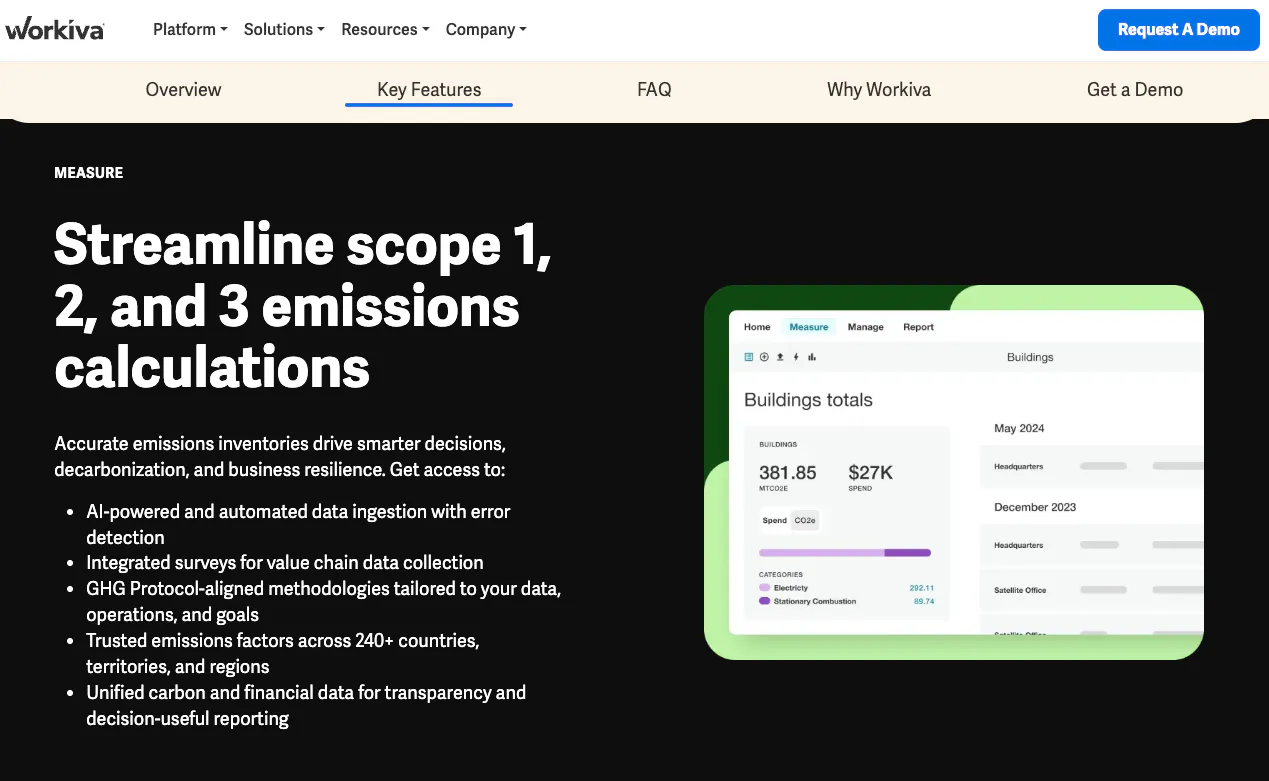
Sweep, a sustainability data management platform, was founded in 2020 and is headquartered in Paris and London. Sweep's core is carbon accounting software that tracks emissions data across the value chain and extends to disclosure. Sweep opened its first US office, in Denver, Colorado, in 2025.
Best for: carbon-focused ESG data management for global teams.
Novisto is an ESG reporting platform built for ESG teams, with a workflow that collects data once and reports it to many frameworks. The platform supports more than 25 ESG taxonomies, with over 2,000 built-in metrics.
Best for: enterprises that collect ESG data once and report to many frameworks.

Cority is an environment, health and safety (EHS) software company whose sustainability module sits next to its environmental, health and safety and quality tools. More than 1,500 organizations use Cority, among them Dow, Toyota and NASA. The sustainability module calculates Scope 1, 2 and 3 emissions against a database of over one million emission factors.
Best for: industrial or high-compliance sectors that already use EHS software.

Start from your reporting obligations and your current data gaps, then count the people who will use the platform every month. Seven checks are worth running before you commit to any of these ESG software solutions or reporting tools:
Customer reviews show how a vendor performs after the sale, so they are worth reading alongside the demo. The platform that fits is the one that matches your reporting obligations and your team's daily work.

Companies in scope for SB 253 have to produce Scope 1 and Scope 2 figures by November 10, 2026 and keep the evidence behind them. Greenly's carbon footprint platform measures those emissions, and its California service adds built-in guidance that catches weak points before formal verification, and an export in the format CARB's intake platform requires. More than 4,000 companies in over 30 countries use Greenly.
SB 261 is paused, which leaves some companies unsure whether to prepare a climate risk report. Greenly maps physical and transition risks under TCFD on the same dataset as the SB 253 inventory, so teams that choose to publish voluntarily have the analysis ready.
To see how this works with your own data, book a demo.
It keeps an audit trail and the evidence behind every figure, so a reviewer can trace a number back to its source data and see who changed it. For California's SB 253, CARB accepts 2026 submissions whether or not limited assurance has been obtained, and a separate rulemaking will cover independent third-party assurance for 2027 and later years.
Yes, for investors, for reporting teams and for companies that do business in California. Verdantix found in 2025 that investor pressure is driving the adoption of ESG software, more than two-thirds of companies that had reported under the CSRD or ISSB told PwC they gained significant or moderate value beyond compliance, and California's first SB 253 emissions reports are due on November 10, 2026.
ESG software manages a company's own sustainability data and turns it into reports, while ESG ratings are standardized ratings of an entity's ESG characteristics or risks, built on a provider's methodology and provided to third parties. A company can use software to prepare the data that rating agencies and investors ask for.
Yes, several platforms cover both. Greenly, Sweep, Novisto and Cority each publish CSRD support, and Greenly and Sweep also publish California SB 253 solutions, so the same platform can handle EU and California reporting.
No. CARB offers a voluntary 2026 Report Intake Platform that entities may choose to use, and emissions reports can also be emailed to CARB. CARB has posted guidance for 2026 submissions, and the work before filing, building the Scope 1 and Scope 2 inventory and keeping the evidence behind each figure, is the part ESG software is built for.
Verdantix, Verdantix Green Quadrant Report Reveals ESG & Sustainability Reporting Software Vendors Shifting Strategies Amid Regulatory Flux

PwC, Global Sustainability Reporting Survey 2025
PwC, Four takeaways for US companies from PwC's Global Sustainability Reporting Survey
California Air Resources Board, California Corporate Greenhouse Gas Reporting: Notice of Availability of 2026 Reporting Resources
California Air Resources Board, CARB approves climate transparency regulation for entities doing business in California
Sullivan & Cromwell, California Air Resources Board's Initial Regulation Under SB 253 and SB 261 is Effective
US Securities and Exchange Commission, SEC Proposes Rescission of Climate-Related Disclosure Rules
Financial Market Authority (Austria), ESG Ratings Regulation: new legal framework for ESG ratings applies from 2 July 2026
Workiva
Sweep
Novisto
Cority
Greenly
Share this article


More articles
View allCarbon Footprint Management Software: Top 10
Compare 10 carbon footprint management software platforms for US businesses: carbon accounting, Scope 3 tracking, reporting and decarbonization tools.

Decarbonization: what it is and why it matters
What is decarbonization, and why is it urgent? Learn practical steps companies can take to support the global move toward net zero emissions.

Impacts, Risks, and Opportunities (IRO) for CSRD Reporting
In this article, we’ll break down what IROs are, how to identify and assess them, and what CSRD requires in terms of disclosure.
