


Decarbonization: what it is and why it matters
1 min
Level
What is decarbonization, and why is it urgent? Learn practical steps companies can take to support the global move toward net zero emissions.


ESG / CSR

Industries


By Kara Anderson, UK Copywriter, on 07/25/2025
Updated by Kara Anderson, on 05/13/2026
As sustainability reporting becomes more regulated, businesses around the world are under growing pressure to disclose clear, consistent information on their environmental and climate-related risks. In response, the IFRS Foundation’s S1 and S2 standards have now moved from voluntary frameworks to the mandatory baseline for major economies, including the UK, Australia, Singapore, and parts of the EU. With the ISSB now finalising IFRS S3 (Nature and Biodiversity), companies are no longer just implementing - they are undergoing high-stakes, audit-ready digital transformations.
But implementing these standards is no easy task. Companies need to collect ESG data across departments, assess climate risks, map disclosures to financial outcomes, and report in a way that satisfies investors and regulators alike.
The 10 best IFRS-aligned sustainability platforms in 2026
The key benefits of using IFRS-compliant software
The right tool for your business
The most common questions about IFRS S1 and S2
With more platforms offering AI-powered workflows, audit-ready exports, and compatibility across global frameworks, choosing the right IFRS reporting tool can feel overwhelming. That’s why we’ve compared the most promising solutions on the market – from intuitive entry-level tools to powerful enterprise-grade platforms.
Below, we reveal our top 10 picks for 2025:
| 🥇 The Top 10 IFRS Tools in 2026 | Highlight Feature |
|---|---|
| 1. Greenly | Real-time IFRS S1/S2 workflows & AI audit gap analysis |
| 2. AMCS ESG REBRANDED | IFRS reporting integrated with physical operational flows |
| 3. Persefoni | Carbon-to-disclosure automation with investor-grade outputs |
| 4. Novisto ACQUISITION | Unified "all-in-one" source of truth with Minimum's carbon engine |
| 5. IBM Envizi | Enterprise ESG reporting aligned to IFRS and CSRD |
| ...and 5 others including CCH Tagetik, Tracera, and Plan A | |
Status: Rebranded and fully integrated into AMCS Platform (May 2026).
Key features:
Best for: Heavy industry and utilities requiring reporting tied to physical operations.
Status: Recently acquired Minimum (March 2026) to unify carbon and ESG metrics.
Key features:
Best for: Enterprises seeking a single "source of truth" to eliminate tool fragmentation.
Pricing: Custom pricing based on company size, number of entities, and modules used
Location: Headquartered in Germany, serving clients across Europe and internationally
Key features:
Types of customers: Lucanet is ideal for mid-sized to large companies looking to centralize ESG and financial data within a single IFRS-compliant reporting environment. Its Excel-friendly design makes it especially appealing to finance teams transitioning from spreadsheet-based workflows to audit-ready sustainability reporting.

Pricing: Enterprise-level pricing available on request, typically based on modules and number of users
Location: Headquartered in the United States, with a global client base and offices across Europe, APAC, and North America
Key features:
Types of customers: Workiva is a top choice for large enterprises and multinational organizations that need to manage complex sustainability disclosures across teams, departments, and geographies. It’s especially well-suite

Pricing: Customized plans based on company size, selected modules, and reporting scope
Location: Headquartered in Germany, with clients across Europe and expanding globally
Key features:
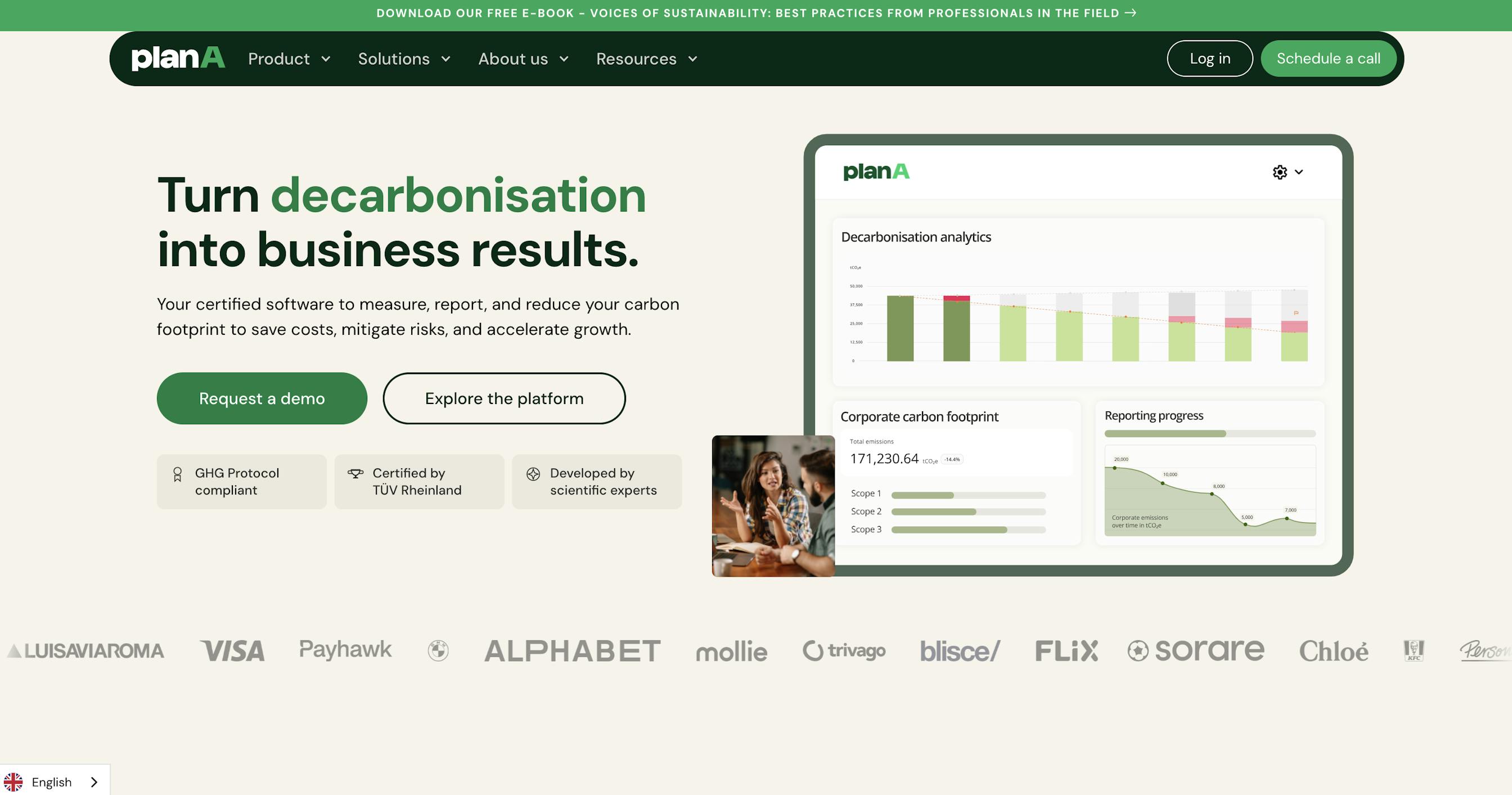
Types of customers: Plan A is well-suited to SMEs and mid-sized companies looking for a flexible, all-in-one ESG suite that supports both IFRS and CSRD compliance. It’s especially valuable for businesses operating in Europe that want to prepare for future regulations while managing emissions, targets, and disclosures from a central platform.
Pricing: Tiered SaaS pricing; available on request based on company size and reporting scope
Location: Based in the UK, with clients across Europe, North America, and Asia-Pacific
Key features:
Types of customers: Tracera is built for mid-sized to large companies that need a practical, collaborative way to structure and automate their IFRS S1/S2 disclosures. It’s especially valuable for teams managing complex data flows across departments or geographies, and for those looking to streamline qualitative reporting through AI.

Pricing: Enterprise pricing available on request; typically modular depending on reporting needs and company size
Location: Global presence through Wolters Kluwer, with strong reach in Europe, North America, and Asia-Pacific
Key features:
Types of customers: CCH Tagetik is best suited for large enterprises and multinational organizations that want to unify financial and sustainability reporting in one platform. Its robust financial integration and modular ESG capabilities make it ideal for CFO-led teams seeking IFRS alignment alongside broader corporate performance management.

Pricing: Custom enterprise pricing depending on scale, modules, and integrations
Location: Headquartered in the United States, with global availability and support
Key features:
Types of customers: IBM Envizi is ideal for large organizations managing complex operations across geographies or business units. It’s particularly valuable for companies with mature sustainability programs that need granular control over data pipelines, predictive analytics, and enterprise system compatibility.

Pricing: Custom pricing depending on modules, user tiers, and integrations
Location: Canada (with global clients across North America, Europe, and Asia)
Key features:
Types of customers: Novisto is particularly popular among mid-sized to large firms with ESG teams managing multi-framework reporting. It’s well-suited for organizations that want both control and flexibility – combining automated data flows with expert-led customization and high levels of assurance.

Pricing: Free ‘Pro’ tier available. Advanced and enterprise plans are priced on request.
Location: United States (with global reach)
Key features:
Types of customers: Large enterprises, financial institutions, and investment firms seeking an audit-grade carbon accounting and climate disclosure platform. Ideal for teams preparing for multiple regulatory frameworks or requiring third-party assurance support.

Pricing: Custom pricing based on organization size, modules selected, and implementation scope
Location: Global (Headquartered in Ireland via AMCS Group, with major hubs in Canada and Europe)
Key features:
Types of customers: Now part of the AMCS 'Environment and Sustainability' suite, it is the premier choice for heavy industries, utilities, and waste management firms that require IFRS-grade reporting integrated into their physical operational workflows and circular economy targets.
Pricing: Pricing available on request – tailored to company size, scope, and support needs
Location: Headquartered in France, with a global client base across Europe, North America, and APAC
Key features:
Types of customers: Ideal for small to large businesses looking to streamline their IFRS S1/S2, TCFD, and CSRD compliance. Especially suited for companies in highly regulated sectors or those seeking investor-grade reporting with expert guidance at every step.

Switching from spreadsheets to a dedicated IFRS reporting platform isn’t just about meeting disclosure requirements – it’s about transforming how your organization approaches climate risk, strategy, and accountability. Here’s what you gain:
With more platforms now supporting IFRS-compliant sustainability disclosures, it can be tricky to know which solution is right for your organization. Here’s what to look for when choosing a reporting tool:
Smaller companies often benefit from intuitive platforms with step-by-step support. Larger or more complex businesses may need a modular, scalable solution with team-based permissions and integrations.
Not all ESG software is purpose-built for the IFRS Sustainability Disclosure Standards. The best tools for IFRS-aligned ESG data offer:
While some platforms repurpose CSRD or SEC modules, the most effective IFRS reporting platforms are designed specifically for global baseline compliance.
IFRS climate disclosures often require input from finance, legal, operations, and sustainability teams. Look for a platform that:
Prices for IFRS-compliant sustainability software vary widely. Be sure to:
IFRS sustainability standards are evolving – and so are stakeholder expectations. Check whether your chosen software can:
Final tips before you choose:
IFRS S1 (General Requirements) and IFRS S2 (Climate-related Disclosures) are the global baseline for sustainability reporting issued by the International Sustainability Standards Board (ISSB). They require companies to disclose material information about sustainability and climate-related risks and opportunities that could reasonably be expected to affect the entity’s cash flows, access to finance, or cost of capital over the short, medium, or long term.
Yes, for many large and listed entities. As of May 2026, IFRS S1 and S2 have been formally adopted or endorsed into mandatory local law in over 25 jurisdictions, including the United Kingdom (via the UK SRS), Australia (via AASB S1/S2), Singapore, and Brazil. Even in jurisdictions without direct mandates, global supply chain pressure and investor demands have made these standards the de facto requirement for international business.
While the IFRS standards focus on financial materiality (how sustainability affects the company), the EU’s Corporate Sustainability Reporting Directive (CSRD) uses double materiality (adding how the company affects the environment and society). However, in 2026, the ISSB and EFRAG have achieved significant interoperability, meaning companies can often use a single IFRS-aligned data set to fulfill the Climate (ESRS E1) portion of their CSRD requirements.
In April 2026, the ISSB issued a Practice Statement on Nature-related Disclosures rather than a mandatory S3 standard. This provides a formal voluntary framework for companies to report on biodiversity, water, and ecosystems, heavily aligned with the TNFD (Taskforce on Nature-related Financial Disclosures). Leading 2026 IFRS tools now include these modules to help companies stay ahead of what is expected to become a mandatory S3 standard by 2027.
Yes. To satisfy the requirements of digital-first regulators and AI-driven investment analysts, reports must now be machine-readable. This involves using the IFRS Sustainability Disclosure Taxonomy to apply XBRL tags to S1 and S2 data points. Modern IFRS software automates this tagging process, ensuring your sustainability data is as discoverable and searchable as your traditional financial statements.
Most mandatory jurisdictions, including the UK and Australia, have officially transitioned to limited assurance requirements for climate disclosures as of the 2026 reporting cycle. This means a third-party auditor must review the report, making it essential to use a platform that provides a "meter-to-report" audit trail and transparent data lineage to avoid greenwashing litigation risks.
IFRS S2 explicitly requires the disclosure of Scope 3 greenhouse gas emissions, recognising that a company’s primary climate risk often sits within its value chain. In 2026, the most effective IFRS tools use AI and primary supplier data to move beyond industry averages, providing the granular data required to meet the S2 standard and satisfy institutional investors.
At the federal level, no. Following the SEC’s decision in early 2026 to pivot toward a voluntary, principles-based framework, there is no nationwide mandate for IFRS S1/S2. However, for US companies doing business in California, compliance is functionally mandatory. California SB 253 and SB 261 require large entities (over $500M–$1B in revenue) to disclose climate risks and emissions using frameworks that are fundamentally aligned with IFRS S2 and the TCFD.
California’s SB 261 specifically allows companies to fulfill their climate-risk reporting obligations by using the IFRS S2 (ISSB) framework. While SB 253 focuses on the GHG Protocol for emissions, the narrative and risk management disclosures required by California align so closely with IFRS that most US multinationals are adopting a "report once, comply everywhere" strategy using IFRS-grade tools.
Greenly supports companies preparing for IFRS-aligned sustainability disclosure, with built-in templates, automated data integration, and guided workflows. Whether you’re adopting IFRS S1 or S2 voluntarily or in anticipation of regulation, our platform is designed to streamline ESG reporting and ensure that it's aligned with investor expectations.
| What we offer | How it helps |
|---|---|
|
1. IFRS-aligned templates and workflows
|
Use built-in templates for IFRS S1 and S2 to structure your disclosures clearly and consistently. |
|
2. Automated data integration
|
Sync data from your finance, risk, and ESG systems to reduce manual work and ensure consistency across reports. |
|
3. AI-assisted disclosure drafting
|
Streamline your reporting process with AI-supported suggestions for key IFRS disclosure fields. |
|
4. Guided reporting support
|
Follow step-by-step workflows that help you understand what’s required – and how to meet it – under IFRS. |
Find out more about our IFRS offering on our dedicated page – or reach out to our team to get started.

 Sources:
 Share this article


What is decarbonization, and why is it urgent? Learn practical steps companies can take to support the global move toward net zero emissions.

In this article, we’ll break down what IROs are, how to identify and assess them, and what CSRD requires in terms of disclosure.

In this article, we break down what the EU CBAM is, how it works, and what businesses need to do to comply.
