
Sustainable Development Goals (SDGs): All You Need to Know
1 min
Level
The United Nations has defined 17 goals, aimed at creating a better world. What are these so-called "Sustainable Development Goals" ? Explanations.


By Stephanie Safdie, US Copywriter, on 12/09/2025
An overview of net zero and how it differs from carbon neutrality
A breakdown of net zero by 2050 and what it means
How to develop an effective net zero strategy
In the race against climate change, more and more companies are committing themselves to adhere to the measures necessary in order to reach net-zero emissions by 2050 – but what does that mean exactly?
Net zero is one of the most commonly discussed topics in the world of sustainability, but it's often confused with carbon neutrality – which can make it challenging for companies to develop an effective net-zero strategy.
In this article, we'll break down what it means to be net-zero, what is a net-zero strategy, and why is it important to incorporate into business models moving forward?


Net-zero is a term thrown around a lot in the environmental world – but do you know what it actually means?
To put it in layman's terms, net-zero means ensuring that the amount of greenhouse gasses or carbon emissions produced and the amount of emissions removed from the atmosphere remain equivalent. Net-zero is achieved when the same amount of emissions that are produced are also removed from the atmosphere.
Many people get confused about the difference between implementing a net-zero strategy and achieving carbon neutrality – but are they truly one and the same?
Many people get easily confused in deciphering the difference between the two terms, “net-zero” and “carbon neutral” thinking that they are one and the same – but they aren’t.
Carbon neutrality is when a company is offsetting the same amount of carbon emissions that they are responsible for – and they often achieve this by investing in carbon offsetting projects.
On the other hand, to be classified as a net-zero company – a company or organization needs to incorporate environmentally friendly tactics that don’t actively increase the rate of carbon emissions produced. Basically, in order to be net-zero, a company needs to offset all of their emissions to the extent that it appears that they don’t emit any greenhouse gasses or carbon emissions at all – hence the term, “net zero” – as the company “technically” reaches a baseline point where they do not add more emissions into the atmosphere.


The main goal of committing to net-zero emissions is to help in the fight against climate change by reducing emissions and balancing carbon sinks – which are forests, oceans, or other various environmental resources that help to absorb carbon dioxide from the atmosphere.
The main goal of being carbon neutral is to also mitigate man-made greenhouse gas emissions and make it seem like they were never produced in the first place, making the main difference between net-zero emissions and carbon neutrality being that net-zero emissions strives to not produce any excess emissions from the start, whereas it is necessary to offset them with carbon neutrality.
The battle cards below will further depict the differences between net zero and carbon neutrality:
A net-zero strategy is the process of creating a plan, often most effective if it is a personalized approach – in order to cut emissions to as close to zero as possible in attempts to adhere to the ideals of the goals delineated in most “net-zero” policies.
Think of net-zero like filling up water in a sink while the drain is still plugging. At a certain point, even with a small hole near the top of the faucet to help drain excess water – the sink will overflow and it will become too much to manage.

That’s why many strive to leave the drain unplugged – so that they can use the water at the same rate in which it is going down the drain to prevent a flood. Net-zero emissions work the exact same way: companies seek to offset or reduce the same amount of emissions that they have previously created in order to create an equal balance of emissions produced and emissions removed.
A net-zero strategy can look different depending on the company or country tackling the excess emissions. The development of a net-zero strategy is also contingent on the amount of financial resources available to the entity in question.
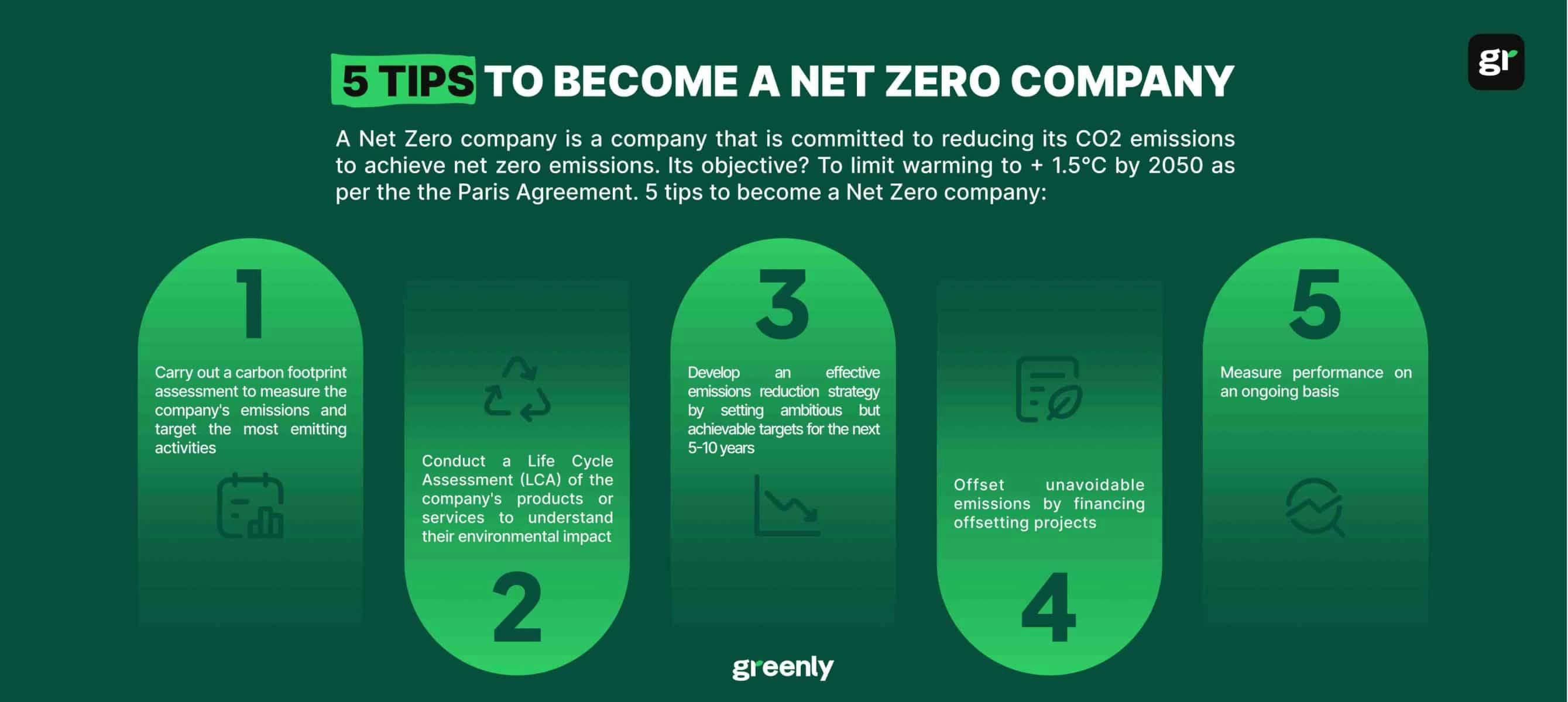
However, it is next to impossible to begin implementing a net-zero strategy until a company is aware of the current rate of their emissions. Therefore, many enterprises seek the help of a third party like Greenly to help them measure their emissions and develop a personalized plan to reduce them more effectively.


While it’s possible to determine how many emissions a company is responsible for alone, it’s genuinely more difficult – as it’s challenging to measure all 3 scopes of emissions alone. Before creating a net-zero strategy, companies must measure both their direct and indirect emissions. After this has been done, then a company can decide how much they are willing to reduce on their behalf, and how much funding is available to invest in other technologies, such as a carbon capture and storage system, in order to offset the residual emissions that they cannot cut back on their own.
The overview cards will reveal some of the most important things about a net-zero strategy:
Establish measurable, science-backed goals aligned with the Paris Agreement to limit global warming to 1.5°C.
Cut Scope 1 and 2 emissions through renewable energy, efficient processes, and sustainable technologies.
Work with suppliers and partners to reduce Scope 3 emissions and promote shared sustainability practices.
Support reforestation, soil carbon capture, or direct air capture to remove residual emissions from the atmosphere.
Monitor progress annually, report transparently, and adjust targets to remain aligned with evolving climate goals.
Involve employees, investors, and communities to build accountability and momentum toward a net-zero future.
Developing a net-zero strategy has never been more important, especially seeing that the global surface temperature isn’t decreasing, let alone stabilizing, as many would hope it would – and given that the IPCC has recently concluded that much of global warming is provoked by human activity, it’s up to those who dwell the planet to implement strategies like a net-zero strategy to reduce emissions and take part in the fight against global warming.
The interactive flip cards below (move cursor over card to flip) will reveal some of the reasons why a net-zero strategy is important:
A net-zero strategy is crucial for any company or individual seeking to reduce their emissions and contribute in the fight against climate change. Working towards net-zero serves as a way for companies to ensure they are continuously putting their best foot forward in reducing emissions and their overall environmental impact, as well as demonstrating to future customers and investors their environmental values – which can also help to stimulate further business and financial gain.
However, this isn’t and shouldn’t be viewed as the main reasons for why implementing a net-zero strategy is important. The paramount reason why a net-zero strategy is pivotal is because it is a methodical plan that can help a company to drastically reduce their emissions and the globe’s overall carbon footprint.

You may have already heard about some net-zero strategies announced by other companies, such as in the Biden administration’s Inflation Reduction Act of 2022 that is set to help the U.S. achieve net-zero emissions by 2050, and the several new plans implemented by the U.K. government – such as their Hydrogen Strategy and the Ten Point Plan.
Net-zero emissions by 2050 has been derived from the new scientific findings that delineate the need to drastically reduce emissions before the year 2050 itself. This is because the amount of human-made emissions need to be reduced by a whopping 45% from the levels found in the atmosphere back in 2010 by 2030 in order to achieve net-zero emissions by 2050. In other words, companies need to hit these specific targets in order to balance out the amount of emissions created and removed before 2050 – similar to the sink and drain analogy explained before.
The overview cards below will reveal additional reasons why so many companies around the world are embarking on their net-zero journey:
Net-zero targets help companies comply with growing climate rules and reporting standards across regions.
Capital increasingly favors credible decarbonization plans, lowering financing risk and cost of capital.
Cutting energy waste and switching to renewables reduces OpEx and exposure to volatile energy prices.
Major customers now require emissions data and targets in RFPs; net-zero keeps suppliers on preferred lists.
Employees and buyers prefer climate-aligned brands, boosting recruitment, retention, and revenue.
Decarbonization limits transition and physical risks, strengthening long-term business continuity.
The problem is that not every country in the world is committed to achieving net-zero emissions by 2050. Although a whopping 137 countries have committed to some form of carbon neutrality, many of them aiming to achieve this around 2050 – some of the world’s greatest emitters such as Russia and India have not implemented the net-zero strategy necessary to help combat global warming. In other words, while the ideal and value behind net-zero emissions by 2050 is a viable net-zero strategy – it may prove ultimately efficacious if other high emitting countries around the world refuse to participate.
Committing to achieving net-zero emissions by 2050 means that countries have to implement a productive net-zero strategy: such as making use of new innovative technologies to offset residual emissions, creating new sustainable habits to reduce emissions in the long-run, and most importantly – having staff members or citizens of the country be willing to participate. After all, net-zero can’t be properly reached if not everyone is committed to a net-zero strategy.
How can you and your company get started with implementing a net-zero strategy?
As explained before, it’s next to impossible to begin establishing a net-zero strategy if your company doesn’t even know how much they emit to begin with. This is why many companies start with recruiting the help of a third-party company, like Greenly, to do a carbon assessment and determine where their excessive emissions are coming from. Only then can a company create a potentially successful plan to reduce their emissions.
Emissions can either be direct, where they come from an owned vehicle or fuel combustion within the company itself, or indirect from an outside source – such as using electricity for heating or powering a central cooling system. Indirect emissions, otherwise known as scope 3 emissions, can also include employee travel, use of products not created within the company, the emissions created through the disposal of waste, or the use of offsite vehicles.
The vertical timeline below will reveal how companies can get started with their own net-zero strategy:
Start by evaluating which scope emissions (direct, energy, and value-chain) create the most impact. Greenly helps quantify your baseline and surface the biggest “hotspots.”
Rank sources by environmental harm and business relevance (e.g., purchased electricity, logistics, suppliers). This focuses effort where reductions matter most.
Build your net-zero strategy with bite-size milestones (the “cut bacon twice a week” approach). Incremental shifts beat abrupt overhauls and help teams stick with the plan.
Create quarterly/annual targets. Use Greenly dashboards to monitor KPIs; when milestones are met consistently, step up ambition and expand the reduction scope.
Execute practical measures—efficiency upgrades, renewable energy, low-carbon procurement, supplier engagement, smarter transport—guided by Greenly’s playbooks and data.
Commit to ongoing tracking & reporting. Greenly streamlines disclosures and keeps methodology consistent so you can share credible progress with stakeholders.
Pursue recognized frameworks that reinforce momentum, such as ISO Certification and aligning to the UNGC’s Sustainable Development Goals.
Review results, update assumptions, and expand actions to more sites, products, and suppliers. Keep raising ambition until the organization reaches credible net-zero.
Two more easy ways your company can get started with developing a net-zero strategy: by investing in carbon offsetting projects and technologies like carbon capture and storage. While both of these can be costly upfront, they can help to ensure that a company’s progress towards reaching net-zero emissions isn’t hindered by an accidental slip of temporary excessive emissions produced by the company. Carbon offsetting projects are when a company financially donates to another organization centered around creating positive environmental change that can help to reduce emissions, such as planting trees, whereas a carbon capture and storage system acts as a vacuum cleaner to remove carbon dioxide from the atmosphere.
As an individual, you can also create a net-zero strategy in your daily life. For instance, whenever you fly – many airlines now offer the option for you to pay for a carbon offsetting project to offset the individual emissions you are responsible for creating from your flight. Small things, like striving to bring reusable shopping bags with you when you go to the grocery store instead of caving in and paying the five cent fee for a plastic bag – can help you be successful in your net-zero strategy.


Clearly, a net-zero strategy can look different for everyone – and is contingent on the amount of resources they have. However, that is ultimately the best part about creating a net-zero strategy: is that it is manipulative and has the creative potential to be effective for anyone and everyone despite whichever way they choose to go about it.
If reading this article about a net-zero strategy and why it is important to implement has made you interested in reducing your carbon emissions to further fight against climate change – Greenly can help you!

National Grid

IEA
RPS
Net Zero Climate University of Oxford
Visual Capitalist
Share this article


More articles
View allSustainable Development Goals (SDGs): All You Need to Know
The United Nations has defined 17 goals, aimed at creating a better world. What are these so-called "Sustainable Development Goals" ? Explanations.
