March 6, 2024
Rule adopted
The SEC approved the climate disclosure rule by a 3-2 vote, with a first compliance date of 2025 for large filers.


By Kara Anderson, UK Copywriter, on 07/02/2026
Updated by Agnès Potier-Murphy
If you've been waiting for clarity on the SEC's climate disclosure rule before planning your own reporting, here's the short answer: there is currently no enforceable obligation under this specific rule. The rule was adopted in 2024, stayed within weeks, and the Securities and Exchange Commission itself proposed scrapping it entirely in May 2026. This article walks through how the rule got here, what the SEC's own rescission proposal argues, and what still applies if your company has exposure to California or the EU regardless of what happens in Washington.
The SEC's climate disclosure rule has never taken effect, despite being formally adopted in March 2024.
The SEC itself voted to stop defending the rule in March 2025, and proposed rescinding it entirely in May 2026.
Even if the SEC rule is rescinded, California's SB 253 is still being enforced, with a Scope 1/2 reporting deadline of August 10, 2026.
California's SB 261, by contrast, is currently not enforced due to a separate Ninth Circuit court order.
The EU's CSRD remains in force but now covers roughly 80% fewer companies after 2026 threshold changes.

Adopted by the U.S. Securities and Exchange Commission on March 6, 2024, the SEC climate disclosure rule would have required public companies to include climate-related disclosures in their SEC filings: Scope 1 and Scope 2 greenhouse gas emissions for large filers, board oversight of climate-related risk, and the financial statement effects of severe weather events. It was stayed within weeks of adoption, before applying to a single filing, and on May 29, 2026 the SEC formally proposed rescinding it in its entirety. As of June 2026, the rule is currently stayed and not enforced, pending final SEC action.
What made the rule so contested wasn't the topics it covered, since some form of climate risk disclosure already existed. It was how far it went: every large filer would have had to measure its emissions, document its methodology, and disclose its governance structure around climate risk on an annual basis, including certain disclosures that were not strictly limited to traditional financial materiality thresholds.
The rule never reached a single company's annual report. Within weeks of its adoption, it was challenged in court, stayed by the Commission itself, and then abandoned by the same agency that wrote it. The whole sequence unfolded over two years before ending with a formal proposal to erase the rule entirely.
The SEC approved the climate disclosure rule by a 3-2 vote, with a first compliance date of 2025 for large filers.
The Commission stayed the rule pending consolidated litigation in the Eighth Circuit (Iowa v. SEC), before it applied to a single filing.
The SEC voted to end its legal defense of the rule, withdrawing its brief from the Eighth Circuit entirely.
The Eighth Circuit paused proceedings, telling the Commission to either reconsider the rule or renew its defense.
The SEC formally proposed eliminating the rule in its entirety, citing lack of statutory authority and four independent policy grounds.
On April 4, 2024, the Commission stayed the rule pending the outcome of consolidated litigation in the U.S. Court of Appeals for the Eighth Circuit. States and private parties had challenged the rule almost immediately after its adoption, with the litigation consolidated under the case Iowa v. SEC.
That stay is the reason the rule remains, in a formal sense, on the books — technically live, but never having governed a single filing.
On March 27, 2025, the Commission voted to end its legal defense of the climate disclosure rule, and staff sent a letter to the Eighth Circuit notifying the court that the SEC was withdrawing its brief entirely: counsel were no longer authorized to advance the arguments the agency had previously filed.
Mark T. Uyeda
SEC Acting Chairman, March 27, 2025
On September 12, 2025, the Eighth Circuit responded by holding the case in abeyance until the Commission either reconsidered the rule through formal rulemaking or renewed its defense. That order put the decision squarely back in the SEC's hands, and the agency's answer arrived eight months later.
On May 29, 2026, the SEC proposed rescinding the climate disclosure rule in its entirety, arguing it exceeds the Commission's statutory authority. The proposal doesn't stop at the authority question, either. Even assuming a court found the Commission had the legal power to adopt the rule in the first place, the SEC argues, in its proposal, four main policy reasons:
Companies are already required to flag material climate-related risks under long-standing rules covering business descriptions, legal proceedings, and risk factors; the SEC argues that existing disclosure rules already cover much of this information, a point that remains debated.
Climate disclosure, the Commission argues, is a divisive social and political issue that falls outside the policy concerns of federal securities law, making a disclosure rule built around that single topic an intrusion into decisions that belong to corporate management, not securities regulators.
Whatever informational benefit the rule might offer to investors who specifically prioritize climate data, the costs imposed on many public companies, particularly large filers — and by extension every one of their shareholders — are disproportionate to that narrower benefit. The SEC's own estimate puts the annualized savings of rescission at $4.9 billion, based on modeled compliance scenarios.
The SEC has stated a policy objective of making public company status more attractive, on the view that the declining number of US public companies is partly driven by the cumulative weight of disclosure obligations. A rule this costly works directly against that goal.
Paul S. Atkins
SEC Chairman, May 29, 2026
The proposal was published in the Federal Register on June 3, 2026, opening a public comment period that runs through August 3, 2026.

A proposed rescission is not a final one. Until the SEC votes to adopt the rescission, the 2024 rule technically remains on the books — stayed and unenforced — while the comment process runs its course.

The Commission estimated that annual compliance costs under the rule, averaged over a company's first ten years of compliance, would have ranged from under $197,000 to over $739,000 depending on filer type — figures that don't include one-time implementation costs on top. Aggregated across all affected registrants, the SEC puts the annualized savings of rescission at approximately $4.9 billion per year over ten years.
Behind that figure lies a principle the rescission proposal returns to repeatedly: disclosure rules should be guided by financial materiality, not by what some investors find interesting. A rule whose costs run this high, for benefits this narrow, fails that test in the Commission's view.
The SEC rule's uncertain fate doesn't affect every climate disclosure obligation a US company might face. California and the EU have their own frameworks, on their own timelines, and both remain operative regardless of what happens in Washington.
California's two climate laws, SB 253 and SB 261, as amended by SB 219, sit in a meaningfully different legal position from the SEC rule, and the two laws aren't even in the same position as each other right now.
The California Air Resources Board, the agency responsible for implementing both laws, approved an initial regulation on February 26, 2026, establishing program fees and a first-year reporting deadline. In November 2025, the Ninth Circuit granted a motion to enjoin enforcement of SB 261 and denied a motion to enjoin enforcement of SB 253 — the same court, acting on the same package of laws on the same day, reaching opposite outcomes for each. Here's how the three frameworks compare as a result:
| Criteria | SEC climate disclosure rule | California SB 253 | California SB 261 |
|---|---|---|---|
| Current status | Stayed since April 2024; rescission proposed May 2026 | In force; CARB enforcing | Enacted, but not enforced pursuant to a court order |
| Who it covers | Would have applied to SEC registrants; never took effect | U.S.-based entities with more than $1 billion in annual revenue doing business in California | U.S.-based entities with more than $500 million in annual revenue doing business in California |
| What it requires | Scope 1/2 emissions (large filers), governance, risk management, financial statement effects | Annual Scope 1 and 2 GHG emissions reporting beginning in 2026; Scope 3 beginning in 2027 | Biennial report on climate-related financial risk and mitigation measures |
| Key date | August 3, 2026: public comment deadline on the rescission proposal | August 10, 2026: first-year reporting deadline, Scope 1 and 2 emissions only | No enforced deadline at present |
The gap between SB 253 and SB 261 is the detail easiest to miss. Both laws come from the same 2023 Climate Accountability Package, both were amended by the same 2024 bill, and CARB approved implementing regulations for both on the same day. Yet one is currently being enforced and the other isn't, purely because of a separate court order that paused SB 261 specifically. A company with California exposure that assumes "California's climate laws are paused" because it has heard about SB 261 could miss a real SB 253 reporting deadline just over a month after the SEC's own comment period closes.
For companies already working toward SB 253 compliance, Greenly's California climate disclosure platform centralizes Scope 1, 2, and 3 data collection and generates reports aligned with CARB's required public disclosure format.
The picture looks different in Europe. The Corporate Sustainability Reporting Directive remains in force, but the EU's 2026 Omnibus simplification package substantially narrowed its reach. On February 24, 2026, the Council of the European Union gave final approval to legislation raising the CSRD's scope thresholds to companies with more than 1,000 employees and above €450 million in net annual turnover. For companies based outside the EU, the updated rules apply only where the parent generates more than €450 million in EU turnover, with an EU subsidiary or branch generating more than €200 million on top of that.
The contrast with the SEC's posture is direct, and the scale of each regulator's pullback is comparable even if the method isn't: where the SEC is proposing to eliminate its rule outright, the EU has chosen to keep the CSRD in place while substantially shrinking who has to comply with it, removing roughly 80% of the companies previously covered by the directive's scope. Both regulators are responding to similar cost concerns; they've simply landed on different remedies.
Marilena Raouna
Deputy Minister for European Affairs, Republic of Cyprus, Council of the EU, February 24, 2026
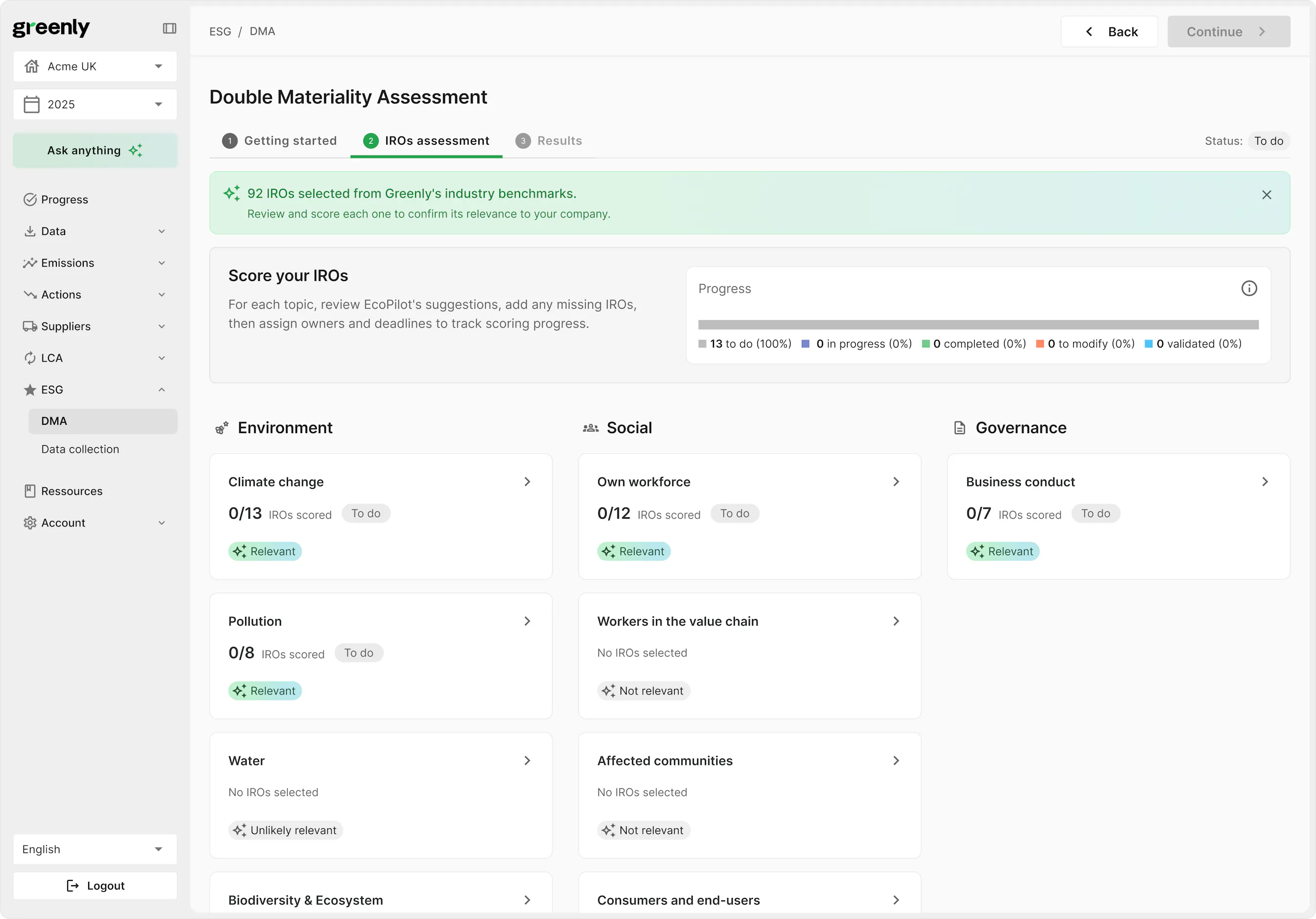
Greenly's Double Materiality Assessment tool, scoring Impacts, Risks, and Opportunities across Environment, Social, and Governance topics.
No. The rule was adopted in March 2024, stayed weeks later, and the SEC formally proposed rescinding it entirely on May 29, 2026. Nothing under this rule is currently due, and the open question now is whether the Commission finalizes the rescission later in 2026, not whether the rule will take effect.

There is no federal obligation to do so, but companies with California or EU exposure still need disclosure-ready emissions data for SB 253 or the CSRD regardless. That same underlying data typically satisfies whichever framework applies, so building it now is rarely wasted effort.
Yes. On March 27, 2025, the Commission voted to end its legal defense of the rule in the consolidated Eighth Circuit litigation, withdrawing its brief entirely.
August 3, 2026 — sixty days after the proposal's publication in the Federal Register on June 3, 2026.
Yes. SB 253 is an independent state law, currently being enforced by CARB, with a first-year Scope 1 and 2 emissions reporting deadline of August 10, 2026 — entirely unaffected by the SEC's rescission proposal.
A Ninth Circuit court order bars CARB from enforcing SB 261, while no such order applies to SB 253. CARB has confirmed that reporting under SB 261 remains voluntary for now.
While the SEC rule heads toward rescission, the disclosure obligations that actually matter for most large US companies — California's SB 253 and the EU's CSRD — are moving forward on fixed timelines. That means the underlying work of measuring, structuring, and verifying emissions data is not optional, and it needs to happen now regardless of what Washington does next.
Greenly's carbon accounting platform is built for exactly this: a single source of Scope 1, 2, and 3 emissions data that satisfies SB 253's CARB reporting format, the CSRD's ESRS requirements, and any future federal framework, without running three separate processes. Over 3,500 companies already use Greenly to turn compliance from a reactive scramble into a continuous, audit-ready workflow.
If SB 253's August 10, 2026 deadline is on your radar, or if you're preparing for CSRD, request a free demo with one of our climate experts — no commitment required.
SEC Proposes Rescission of Climate-Related Disclosure Rules, U.S. Securities and Exchange Commission, May 29, 2026

SEC Votes to End Defense of Climate Disclosure Rules, U.S. Securities and Exchange Commission, March 27, 2025
Rescission of Climate-Related Disclosure Rules, Federal Register, June 3, 2026
CARB Approves Climate Transparency Regulation for Entities Doing Business in California, California Air Resources Board, February 26, 2026
Council Signs Off Simplification of Sustainability Reporting and Due Diligence Requirements to Boost EU Competitiveness, Council of the European Union, February 24, 2026
Carbon Accounting Explained: 2026 Business Guide, Greenly
California Climate Accountability Package: SB 253, SB 261 & SB 252, Greenly
Share this article



In this article, we’ll break down what IROs are, how to identify and assess them, and what CSRD requires in terms of disclosure.

What is decarbonization, and why is it urgent? Learn practical steps companies can take to support the global move toward net zero emissions.

In this article, we break down what the EU CBAM is, how it works, and what businesses need to do to comply.
