
Impacts, Risks, and Opportunities (IRO) for CSRD Reporting
1 min
Level
In this article, we’ll break down what IROs are, how to identify and assess them, and what CSRD requires in terms of disclosure.


By Stephanie Safdie, US Copywriter, on 09/01/2026
Updated by Agnès Potier-Murphy
Carbon accounting is the process of measuring, tracking, and reporting a company's greenhouse gas emissions, essentially a financial audit for your environmental impact. It matters more than ever right now: as climate disclosure rules tighten and stakeholders demand real transparency, companies are under pressure to do more than just go green. You need to know exactly where your emissions are coming from, how to measure them accurately, and, most importantly, how to bring them down.
This guide gives you a structured way to do exactly that: from building an accurate emissions inventory to using that data as the foundation for credible sustainability reporting and a realistic path to net-zero.
The Fundamentals: How the process actually works.
The Frameworks: The methodologies and standards businesses use to stay accurate.
The Strategy: How your company can turn raw emissions data into practical, effective climate action.

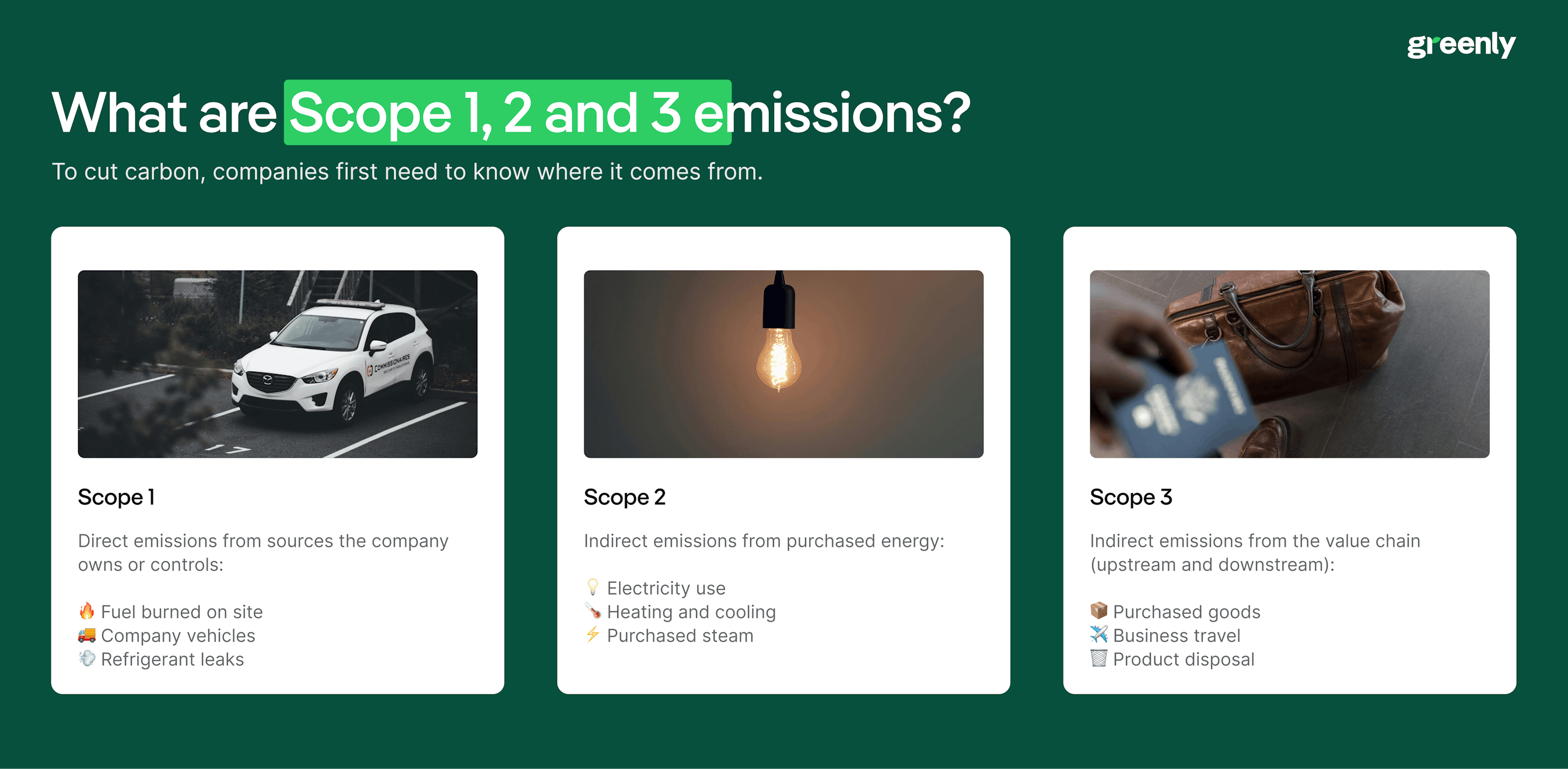
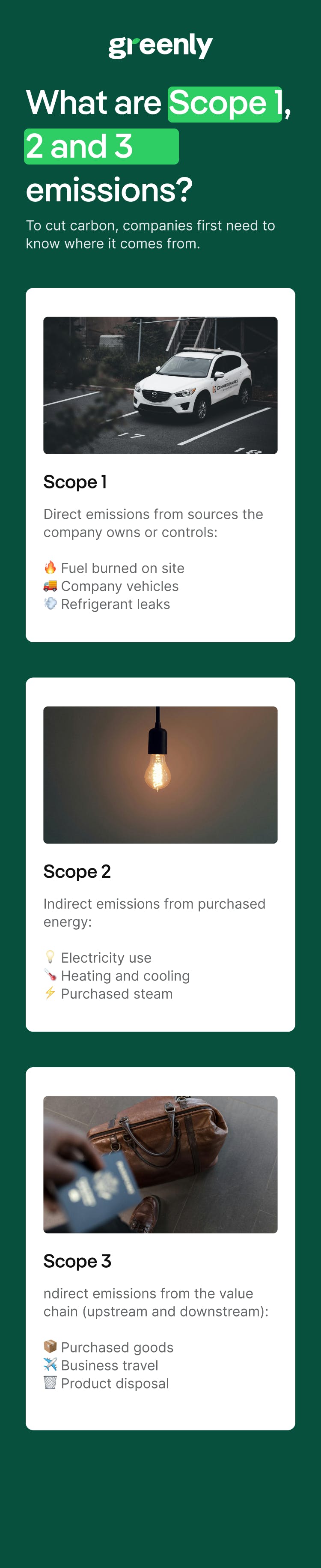
Carbon accounting (also called GHG accounting or climate accounting) is the standardized measurement, calculation, and reporting of an organization's greenhouse gas emissions, across direct operations (Scope 1), purchased energy (Scope 2), and the wider value chain (Scope 3), expressed in a single common unit, carbon dioxide equivalent (CO₂e).
In practical terms, carbon accounting (or GHG accounting, or climate accounting) works like bookkeeping: instead of tracking dollars and cents, you're tracking greenhouse gases, from the energy you buy to the emissions embedded in your entire value chain. The output of that work is what eventually becomes carbon reporting, the disclosures, filings, and public statements that show regulators, investors, and customers what you've measured. Accounting is the calculation; reporting is how you communicate it outward, even though the two are closely intertwined in practice.
Carbon accounting isn't just guesswork; it’s a structured three-step process:
Gather activity data such as electricity bills, fuel receipts, and procurement records.
Apply emissions factors to convert activity data into CO₂e.
Pull results into a formal emissions inventory showing total impact.

Most organizations rely on the Greenhouse Gas Protocol - the gold standard for how emissions should be categorized. But it’s important to remember that carbon accounting isn’t a one-time project. It’s an ongoing cycle that helps you sharpen your data accuracy over time.
At its core, this process answers two vital questions: Where are our emissions coming from, and how big is our footprint? Once you have those answers, you have the foundation you need to set targets and build a real climate strategy.
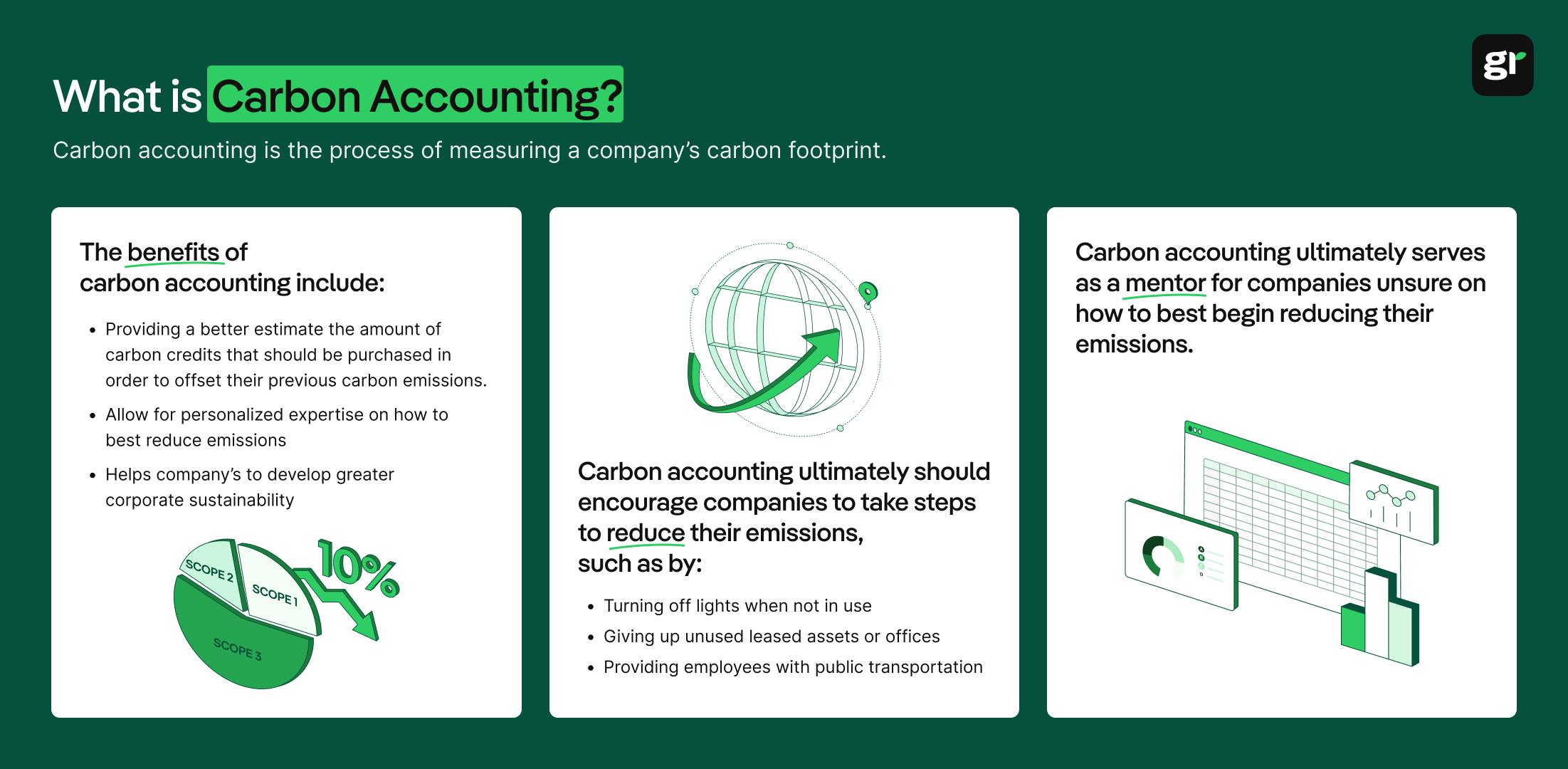

The truth is: if you want to manage your company’s future, you have to measure its impact today.
Here are the five key benefits of carbon accounting driving this shift right now:
Requirements are tightening unevenly across regions, from California's SB 253 to the EU and UK's evolving frameworks. Proper accounting keeps you audit-ready regardless of which mandate lands first.
Carbon data is now a financial KPI. Transparent reporting builds credibility with investors, lenders, and insurers.
Emissions data highlights inefficiencies. Reducing carbon often directly reduces operational costs.
Identify exposure to climate and regulatory risks across your value chain and improve resilience.
Track performance with credible data and avoid unsubstantiated sustainability claims.
Carbon accounting is a structured, repeatable process that converts business activity into measurable greenhouse gas (GHG) emissions. For companies, the objective is not just to calculate a footprint once, but to build a system that produces consistent, audit-ready data over time.
Define Boundaries
Collect Data
Calculate Emissions
Consolidate Results
Validate & Improve
Before counting anything, you must determine what is included in your footprint. Most companies follow the Greenhouse Gas Protocol, which requires defining:
What it defines: Which entities are included in your carbon footprint.
Approach:
What it defines: Which emission sources are included.
Focus:

Why this matters: Poor boundary definition leads to inconsistent reporting, making it impossible to compare your progress over time.
Once the boundaries are set, you gather activity data - the raw inputs for your calculations. Typical sources include:
You’ll likely deal with two types of data:
To make sense of the data, activity (like liters of fuel) is converted into emissions using emission factors.
These factors come from recognized global databases and allow you to express all different greenhouse gases in a single, standard unit: carbon dioxide equivalent (CO₂e).
Next, you consolidate these calculations into a GHG inventory. This master dataset acts as your total carbon footprint. It allows you to:
To meet international standards, emissions are categorized into three Scopes:
Your choice of method depends on your data quality and goals:
The process doesn't end with a number. To stay credible, companies must:
Internal checks or third-party assurance to ensure accuracy.
Disclose data through frameworks such as CDP or regulatory requirements.
The short answer is Yes, it is, at least in a growing number of jurisdictions. However, what's actually required varies significantly by region. While the shift toward mandatory reporting is a global trend, the specific requirements depend heavily on where you operate. Understanding these regional frameworks is the first step in ensuring your carbon accounting system is fit for purpose.
Regardless of where you operate, three trends are now non-negotiable:

The core standards are the GHG Protocol for measurement, ISO 14064 for verification, CDP for disclosure, SBTi for target-setting, and ISSB/IFRS for financial integration. Carbon accounting isn't defined by a single methodology. Instead, it operates within an ecosystem of frameworks that ensure emissions data is consistent, comparable, and - above all - useful for making decisions.
For most companies, the challenge isn't choosing one framework; it’s understanding how they fit together across five key functions: calculation, verification, disclosure, strategy, and financial integration.
The Greenhouse Gas (GHG) Protocol is the undisputed gold standard for measurement. It underpins nearly all corporate carbon reporting globally by defining Scopes 1, 2, and 3 and the specific rules for building a consistent emissions inventory.
The GHG Protocol is a suite of distinct standards tailored to different needs:
In practice, almost every company reporting emissions today is following the GHG Protocol - either directly or via a regional framework aligned with it.
Once you’ve calculated your numbers, you need to prove they are accurate. ISO 14064 provides the rigorous guidance needed to structure and validate your data. It focuses on:
It essentially bridges the gap between your internal spreadsheets and the external assurance an auditor needs to see.
After calculation and validation, you must communicate your findings. CDP (formerly the Carbon Disclosure Project) has become the de facto global disclosure system. It collects environmental data and scores companies on their transparency and performance.
Disclosure via CDP is increasingly expected by:
Measurement alone isn't enough; stakeholders expect you to reduce emissions in line with climate science. The Science Based Targets initiative (SBTi) provides the framework for this.
SBTi allows companies to set reduction targets aligned with the 1.5°C global warming pathway. It is considered the benchmark for credibility because it requires:
A major shift in 2025 and 2026 is the movement of carbon data into financial reporting. The International Sustainability Standards Board (ISSB), specifically through IFRS S1 and S2, is standardising this process globally, absorbing the climate-disclosure recommendations of the Task Force on Climate-Related Financial Disclosures (TCFD), which formally disbanded in 2023 once its work was folded into this newer framework.
These standards aim to align sustainability disclosures with financial statements, requiring companies to disclose:
While the theory of carbon accounting is straightforward, doing it at scale is a significant undertaking. Most organizations quickly realise that the hurdle isn't just the math - it's building the systems, governance, and data pipelines required to produce reliable results year after year. In short, carbon accounting is less about sustainability and more about enterprise-wide data management.
Carbon accounting comes with a growing list of sustainability terms that are often used interchangeably - even though they refer to very different things. Before wrapping up, it’s worth clarifying a few of the concepts that companies most commonly confuse.
Although closely related, carbon accounting and carbon assessment are not the same thing.
A company can complete carbon accounting without taking meaningful action. A carbon assessment is what transforms emissions data into operational and strategic decisions. Both feed into carbon reporting, the disclosures and filings that communicate your numbers, and increasingly, the strategy behind them, to regulators, investors, and customers.
These two terms are frequently confused, but they represent very different levels of climate ambition.
These aren't abstract distinctions. Apple committed in 2020 to 100% carbon neutrality across its supply chain and products by 2030, built on a real reduction target plus high-quality carbon removal for what's left, mechanically closer to net-zero discipline than the offset-heavy version of "carbon neutral." Microsoft went further the same year, pledging to be carbon negative by 2030, cutting emissions by more than half across its direct operations and entire value chain, then removing the rest, with a longer-term goal of removing everything it's emitted since its 1975 founding by 2050. Neither company is there yet, and both illustrate exactly why the accounting has to come first: you can't credibly reduce, remove, or offset what you haven't accurately measured.
In many regions, yes, though the details vary and keep shifting. California's SB 253 already requires Scope 1 and 2 disclosure, with Scope 3 following in 2027, and New York is advancing a closely modeled law of its own; the EU's CSRD applies to a narrower set of large companies following its 2026 simplification; and the US SEC has proposed rescinding its own climate disclosure rule rather than expanding it. Requirements vary by company size, sector, and geographic presence, so check what applies to yours directly.
Most companies begin with operational and financial data they already have access to, such as utility bills, fuel consumption, procurement records, supplier information, business travel expenses, logistics activity, and waste data. The goal at the beginning is not perfect precision, but establishing a reliable baseline that can gradually improve over time as reporting systems mature.
The timeline depends largely on company size, operational complexity, and data maturity. An initial carbon footprint assessment can often be completed within a few weeks, but building a fully integrated and audit-ready carbon accounting system is typically a longer-term process that evolves over several reporting cycles as organizations improve data quality, supplier engagement, and internal governance.
Yes. While enterprise carbon accounting still faces the most regulatory pressure, and typically requires more granular data across multiple business units and subsidiaries, small and medium-sized businesses are increasingly adopting carbon accounting too, driven by customer expectations, supply chain requirements, investor pressure, and sustainability commitments. Many SMEs begin with simplified reporting approaches before gradually expanding the sophistication and accuracy of their systems as they scale.
A carbon accountant measures, tracks, and reports an organization's greenhouse gas emissions, translating activity data like energy bills and travel records into a standardized emissions inventory. The role blends data analysis, regulatory knowledge, and increasingly, software fluency, as more companies bring carbon accounting in-house rather than outsourcing it entirely.
Either can work. Carbon accounting services suit companies without internal sustainability expertise or bandwidth, offering hands-on support for complex Scope 3 calculations. Many companies instead choose software like Greenly's platform to build in-house capability, combining automation with expert guidance rather than outsourcing the whole process.
Spreadsheets can support early-stage carbon calculations, but they quickly become difficult to manage as reporting requirements become more complex. Carbon accounting software, or any dedicated carbon accounting solution, helps organizations centralise emissions data, automate calculations, improve traceability, support audit readiness, and manage Scope 3 emissions at scale - particularly for companies preparing for frameworks such as CSRD or investor-focused disclosures.
Most organizations conduct formal carbon reporting annually, but many companies are moving toward more continuous or quarterly monitoring as climate reporting expectations increase. More frequent tracking improves decision-making, helps organizations identify operational inefficiencies faster, and supports stronger disclosure and audit readiness over time.
Predictive modeling sits on the carbon assessment side of the process, using your emissions data to shape strategy rather than just measure it. Greenly's Trajectory Builder extends your accounting data directly into decarbonization strategy, running real-time simulations and benchmarking your reduction scenarios against industry peers, so you move from measurement to a defensible reduction pathway without switching platforms.
Start from the calculation methodology you need: spend-based, activity-based, or hybrid, since not every platform supports all three equally well. From there, confirm it maps to the standards you're actually reporting against (GHG Protocol coverage is the baseline, but support for frameworks like California's SB 253 varies by vendor), and ask specifically how Scope 3 supplier data gets collected, since that's where platforms differ most in practice.


Greenly, "What is the Greenhouse Gas Protocol?"

Greenly, "What is an emission factor?"
Greenly, "ISO 14064: objectives and requirements"
Greenly, "Greenhouse gas emissions: scopes 1, 2, and 3"
Greenly, "Our guide to the Carbon Disclosure Project (CDP)"
Greenly, "What is the Science Based Targets initiative (SBTi)?"
Greenly, "What are IFRS Sustainability Disclosure Standards?"
Greenly, "What's the difference between carbon neutral and net zero?"
Greenly, "What is the Corporate Sustainability Reporting Directive (CSRD)?"
United States Environmental Protection Agency (EPA), "Scopes 1, 2 and 3 emissions inventorying and guidance"
Harvard Business Review, "We need better carbon accounting. Here's how to get there"
Supply Chain Solutions Center, "Carbon accounting resources"
World Business Council for Sustainable Development (WBCSD), WBCSD homepage
GHG Protocol, GHG Protocol homepage
GHG Protocol, "Corporate Value Chain (Scope 3) Standard"
GHG Protocol, "Corporate Standard"
GHG Protocol, "You, too, can master value chain emissions"
CDP, CDP homepage
ISO, "ISO 14064-1:2018"
Science Based Targets initiative, SBTi homepage
IFRS Foundation, "International Sustainability Standards Board"
Task Force on Climate-Related Financial Disclosures (TCFD), TCFD homepage
UK Government, "Environmental reporting guidelines, including mandatory greenhouse gas emissions reporting"
UK Government (DBT), "UK Sustainability Reporting Standards: UK SRS S1 and UK SRS S2"
SEC, "Press release on proposed rescission of climate disclosure rules"
California Air Resources Board (CARB), "SB 253 reporting deadline bulletin"
New York State Senate, "Senate Bill S9072"
European Commission, "Corporate sustainability reporting"
Microsoft, "Microsoft announces it will be carbon negative by 2030"
Sustainability at Google, "Operating sustainably"
Environment Energy Leader, "Google has invested $3.5 billion in renewable energy projects worldwide"
Apple Newsroom, "Apple commits to be 100 percent carbon neutral for its supply chain and products by 2030"
Share this article


More articles
View allImpacts, Risks, and Opportunities (IRO) for CSRD Reporting
In this article, we’ll break down what IROs are, how to identify and assess them, and what CSRD requires in terms of disclosure.

Decarbonization: what it is and why it matters
What is decarbonization, and why is it urgent? Learn practical steps companies can take to support the global move toward net zero emissions.

The Carbon Border Adjustment Mechanism (CBAM)
In this article, we break down what the EU CBAM is, how it works, and what businesses need to do to comply.
