

Supplier engagement is where a company's sustainability strategy meets the emissions it doesn't control directly: gathering the data, setting clear expectations, and helping suppliers act on them. A company's own operations are rarely where the bulk of its climate impact sits. It's spread across the factories, farms, and service providers behind everything a business buys, and CDP, the UK-founded non-profit running the world's largest corporate climate disclosure system, puts that external footprint at around 26 times what a company generates directly.
For many UK businesses, this shows up as a live request rather than a distant deadline: large customers reporting under the EU's CSRD need Scope 3 data from their suppliers now, regulated or not. The UK's own framework, UK SRS, moves more slowly, though plenty of UK businesses are already setting SBTi-aligned targets voluntarily, well ahead of any mandate. Either way, a supplier data pipeline takes years to build, so the businesses that start now are the ones with something to show later.
Supplier engagement and supplier relationship management (SRM) solve different problems, despite the overlapping language.
On average, a company's supply chain emissions run about 26x higher than its own direct footprint (CDP).
Scope 3 reporting becomes mandatory under California’s SB 253 in 2027, which means supplier data pipelines need to be built well before then.
Large UK suppliers may already be fielding Scope 3 data requests from EU customers reporting under CSRD, with UK SRS bringing similar pressure domestically from 2027.
A five-step framework, grounded in the GHG Protocol and SBTi's own guidance, can take a programme from mapping suppliers to tracking results.
Results are real, but rarely fast. Even well-known UK names fall short of their own Scope 3 targets years into a supplier engagement programme.
What Is Supplier Engagement?

Supplier engagement is an ongoing relationship in which a company gathers real emissions data from its suppliers, holds them to clear environmental standards, and helps them act on the results, usually as one strand of a broader Scope 3 strategy.
Supplier engagement, as this guide uses the term, is about closing the gap between what a company knows and what its suppliers actually emit. Rather than estimating a supplier’s climate impact from spend data alone, a company goes directly to the source: asking, checking, and following up until the numbers are real.
What this actually involves, in practice, is sending suppliers a structured request for emissions data, usually through a questionnaire; pushing them toward setting their own science-based targets rather than just reporting a number; and backing that ask with real support, training, shared calculation tools, and incentives, so it doesn’t land as an unfunded mandate. Some people use the term “vendor engagement” interchangeably, though “supplier engagement” is the more established expression in UK climate and procurement circles.
This is a different discipline from early supplier engagement (sometimes called early supplier involvement), which brings suppliers into product design and development early to improve cost, quality, or lead times. That’s a procurement and engineering practice aimed at product development, distinct from the climate-focused sense used here, though the two terms turn up in a lot of the same search results.
What’s the Difference Between Supplier Engagement and Supplier Relationship Management (SRM)?
SRM, or supplier relationship management, is the label procurement teams already use for working with suppliers, and is often confused with vendor management. The two disciplines get lumped together online, but they’re judged on different things. SRM tracks contract compliance, delivery performance, product quality, and unit cost, the standard scorecard procurement teams have run for years. Supplier engagement narrows the focus to a single dimension of that same relationship: how a supplier performs on emissions and broader climate impact.
There’s a third meaning worth ruling out too. In UK public sector procurement, supplier engagement is a defined stage of the tender process under the Procurement Act 2023, covering, for instance, market consultation before a contract is advertised and handling bidder questions once it’s live. That’s a legal and procedural term, unrelated to climate performance, and it comes up often enough in search results that it’s worth being clear which meaning this guide uses.
Here’s how the two compare directly:
| Supplier Relationship Management (SRM) | Supplier Engagement | |
|---|---|---|
| Primary focus | Cost, quality, delivery, and overall relationship health | Environmental and climate performance, particularly greenhouse gas emissions |
| Typically owned by | Procurement and sourcing teams | Sustainability or ESG teams, working alongside procurement |
| Core metrics | On-time delivery rate, defect rate, cost savings, contract compliance | Emissions data coverage, share of suppliers with science-based targets, questionnaire response rate |
| Common tools | ERP and procurement platforms, supplier scorecards | Carbon accounting software, CDP questionnaires, EcoVadis assessments |
| When it matters most | Every supplier relationship, regardless of sustainability profile | Suppliers with material emissions or compliance exposure, such as Scope 3 reporting obligations |
This distinction will probably matter less over time than it does today, since procurement and sustainability teams are already borrowing from each other’s playbooks. But for now, giving supplier engagement its own accountable owner and its own way of measuring success keeps emissions work from getting folded into, and outweighed by, the much older set of procurement priorities.
Why Does Supplier Engagement Matter Right Now?
The regulatory picture here has two tracks, and the faster one isn’t really about UK law at all. Under the EU’s CSRD, a UK-headquartered group with enough European turnover, and a large enough EU subsidiary or branch, has to file a group sustainability report from 2028. Plenty of UK businesses sit below that threshold and still feel the pressure, because their customers don’t. Any UK supplier selling into a company that already reports under CSRD is likely fielding Scope 3 data requests now, whether or not its own numbers ever get filed in Brussels.
The UK’s domestic track, UK SRS, is moving more slowly. The Financial Conduct Authority has proposed mandatory climate reporting against UK SRS for listed companies from 2027, but even then, Scope 3 disclosure would only be required on a comply-or-explain basis, at least at first. That gives UK businesses a real, if narrow, window to build the supplier data pipeline before it’s mandatory.
Separate from the regulatory case is the financial one. CDP estimates that climate-related risk sitting in corporate supply chains adds up to $162 billion globally, while the upside, savings and new revenue available through supplier decarbonisation, comes to roughly $165 billion. That’s over eight times the $20 billion CDP puts against capturing it.

Elfrun Von Koeller
Managing Director and Partner, BCG, March 2023
Most UK businesses aren’t positioned to capture that value yet, and the gap looks to be widening. EcoVadis’s own ratings data shows 18% of large UK companies still scoring at Partial or below on sustainability performance, more than double the 7% recorded in France and 9% in Sweden. Germany’s large companies have pulled further ahead again since introducing their own supply chain due diligence law in 2023. EcoVadis’s own conclusion: with major trading partners already responding to regulatory pressure, large UK companies have little room to wait.

Three figures sum up the case for UK businesses: Scope 3 data requests that may already be arriving from CSRD-reporting customers, roughly $165 billion in supplier-decarbonisation value according to CDP, and an 18% share of large UK companies still lagging on sustainability performance, well behind single-digit rates among key European peers.
Put those three pieces together, regulation already biting for some, undeniable financial stakes, and a market not yet keeping pace, and the practical question becomes unavoidable. But what does building a supplier engagement programme actually look like?
How Do You Build a Supplier Engagement Programme?
Two organisations have done most of the groundwork here: GHG Protocol and SBTi, both of which publish their own detailed guidance for building a supplier engagement strategy, and the two overlap closely enough to merge into a single five-step model. Sequencing is where most programmes actually struggle: keeping the same supplier moving through all five stages instead of losing momentum after the initial data request.
Map & Prioritise
Focus first on the suppliers responsible for the biggest share of spend or emissions.
Get Buy-In
Bring procurement, finance, legal, and leadership on board before contacting anyone.
Set Requirements
Spell out exactly what’s expected, and explain why it matters.
Support Suppliers
Pair every requirement with hands-on coaching, shared tools, and real support.
Track & Incentivise
Keep tabs on progress and reward the suppliers who actually follow through.
Map Your Supply Chain and Prioritise Suppliers
Not every supplier deserves the same attention on day one. GHG Protocol’s guidance points to a simple rule of thumb: work outward from whichever suppliers make up roughly 80% of spend or estimated emissions, however that group happens to be defined for a given business. In most cases, it’s a fairly short list, which keeps the opening phase realistic rather than trying to contact every vendor simultaneously. Sorting suppliers into Tier 1, Tier 2, and Tier 3, based on how close they sit to the business, is what makes that prioritisation possible in the first place.
Get Internal Buy-In Before Reaching Out
A supplier engagement programme pulls in more internal teams than most people expect going in. The supplier relationship itself usually sits with procurement, but finance will want to see the cost picture, legal needs to check anything going into a contract, and leadership has to be seen actively backing it for suppliers to take the request seriously. SBTi puts this alignment work right at the start of its own framework, before any supplier contact begins. Skip that step, and the cracks tend to show up later as mixed messages across different supplier conversations.
Set Clear, Specific Requirements
A vague question usually gets a vague reply. GHG Protocol lays out a communication sequence worth following closely: say why the request is being made, spell out precisely what’s needed, give a workable deadline, name someone the supplier can actually contact with questions, and confirm once their response has landed. Missing any of these, particularly the "why," is a common reason response rates stay flat. Where a company already has a supplier code of conduct or a wider supplier management policy in place, this is a natural moment to point back to it, since suppliers take a request more seriously when it’s anchored to something formal they’ve already agreed to, rather than one that lands with no context at all.
Back Requirements With Real Support
A requirement on its own won’t move a supplier who genuinely doesn’t know how to meet it. This is especially true of smaller suppliers, who often don’t have anyone in-house capable of building an emissions inventory unassisted. SBTi points to group training sessions, shared calculation tools, and one-to-one support as what separates a truly engaging programme from one that just collects excuses. None of this has to cost much: something as simple as one webinar covering the basics of an emissions calculation can be enough to turn around companies that would otherwise ignore a cold request.
Track Progress and Use Incentives
There needs to be some way of telling whether a programme is actually working. This means keeping an eye on data completion rates, how many suppliers have a stated reduction target, and year-on-year movement against a baseline. Incentives are what push those figures further: preferred-supplier status, longer contract terms, or public recognition for top performers, anything that gives a supplier a reason to treat the request as more than box-ticking. SBTi lists incentives, alongside communication, training, and data collection, as one of the elements to reassess once a programme has had a year or two to root in.
What Tools and Platforms Support Supplier Engagement?
Spreadsheets and email chains work fine for a handful of suppliers, but once a programme spans dozens or hundreds of relationships, keeping track becomes its own job: who’s already been reached, who’s replied, whose data never turned up, and whose figures need a second look. That’s the point where dedicated supplier engagement software starts to pay for itself, pulling data collection, reminders, and response tracking into one place instead of several inboxes.
Most tools and platforms here handle broadly the same tasks: a portal suppliers use to submit data and answer questionnaires, automatic chasing for anyone who hasn’t responded, dashboards showing response and completion rates, and a clear enough trail to stand up to scrutiny during a Scope 3 disclosure. The real difference between them is how well that technology talks to the rest of a company’s carbon accounting setup. If supplier data sits in a separate system from everything else, someone ends up re-entering it by hand.
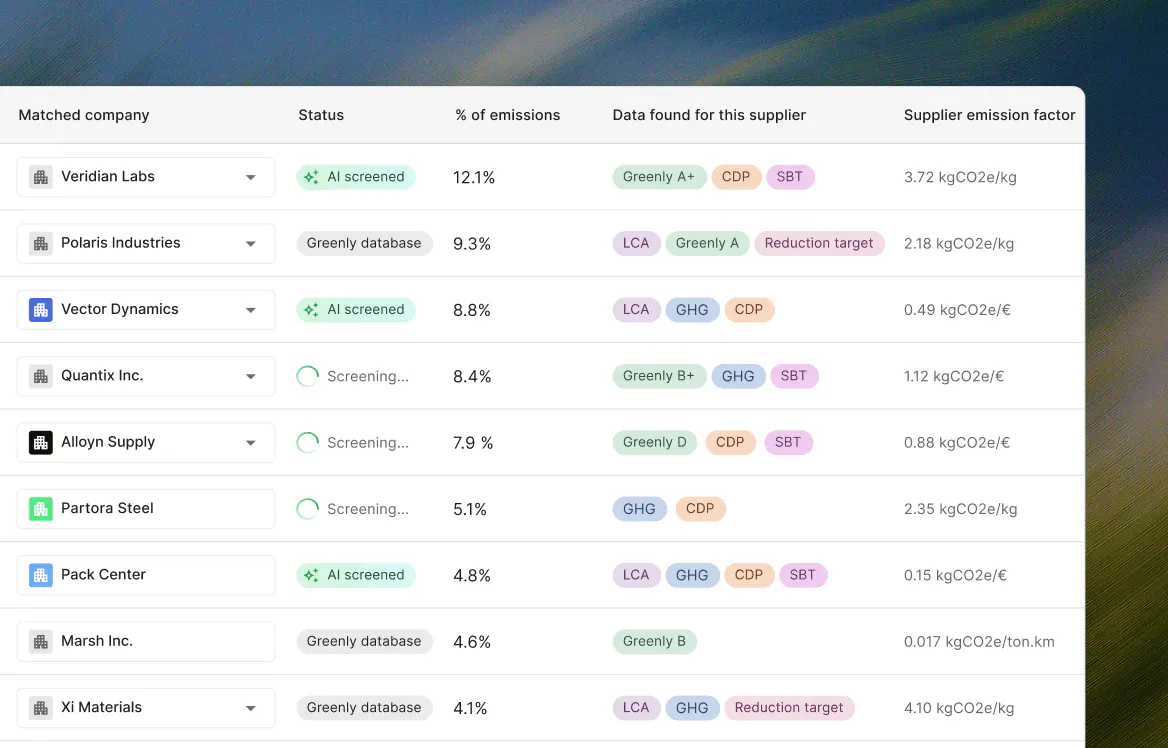
Greenly’s Sustainable Procurement module starts before any supplier is actually contacted: it runs the supplier list against a database of more than 200,000 known suppliers, then scans public SBTi and CDP disclosures to fill in what it can from there. Only suppliers with a genuine data gap left get an outreach request, and even then, the request comes prefilled with whatever’s already known rather than starting from a blank page. Once a supplier’s data is validated, it automatically overwrites the spend-based estimate sitting in the company’s Scope 3 report, all inside the same platform used for the rest of its carbon accounting.
Alexis Normand
Co-founder and CEO, Greenly, November 2022
What Does Supplier Engagement Look Like in Practice?
The five-step version is tidy, but real supply chains rarely are, which is why it helps to see how two UK companies, working in very different industries, have actually gone about this: Tesco in retail, and BT Group in telecoms.
Tesco’s approach leans on encouragement and support rather than a hard requirement. Suppliers accounting for 80% of the company’s cost of goods are being asked to set net-zero ambitions, and as of January 2024, more than 70% had done so publicly. Behind that number sits the Tesco Supplier Network, a knowledge-sharing hub, quarterly drop-in sessions on carbon reporting, and Manufacture 2030, a shared platform suppliers use to submit their data. Tesco doesn’t publish an equivalent supply-chain progress figure, though. Unlike its Scope 1 and 2 numbers, which it reports and updates precisely, progress on the emissions actually tied to suppliers and farmers isn’t broken out with the same precision, itself a sign of how much harder that data is to pin down.
BT Group’s route is structural. Environmental and social criteria now carry a mandatory minimum weighting in every competitive sourcing event the company runs, and a separate push targets its biggest emitters directly: suppliers responsible for more than 63% of BT’s supply chain footprint now report through CDP. The company’s SBTi-validated target is a 42% cut in supply chain emissions by 2031, measured against an FY17 baseline, with 33% already achieved.
Mechanism
Voluntary supplier ambition-setting, backed by training and a shared reporting platform
Key metric
70% of supplier (by cost of goods) have publicly set net-zero ambitions (Jan 2024); no equivalent supply-chain emissions figure published yet
Timeframe
Supplier reporting policy introduced 2021, ongoing
Mechanism
Mandatory ESG weighting built into competitive sourcing, plus a targeted push on CDP reporting
Key metric
Suppliers covering 63%+ of supply chain emissions report to CDP; supply chain emissions down 33% against a 42% 2031 goal
Timeframe
SBTi commitment since 2017, sourcing policy updated as part of FY26 reporting
Both companies still have real ground to cover against their own targets, years after starting.
Does Supplier Engagement Actually Reduce Emissions?
A peer-reviewed study published in Frontiers in Sustainable Energy Policy in 2025 examined this question directly and found that supplier engagement programmes frequently fail to produce measurable cuts in Scope 3 emissions, largely because buyer and supplier data standards don’t line up, and the sheer administrative cost of running a programme at real scale. This is true even for programmes built around SBTi’s own framework, the one behind most of the guidance in this article.
Tesco’s own data gap, mentioned above, is a live example of this very problem: a company with a precise, well-reported operational emissions figure, and no equivalent number yet for the emissions actually sitting with its suppliers and farmers.
There’s a more encouraging figure too. Among companies EcoVadis has rated for ten years or longer, the average score sits at 63.2, against 51.5 for those being rated for the first time. That difference doesn’t establish cause and effect on its own, but it does fit the pattern both Tesco and BT Group show: real progress accumulates gradually, across repeated cycles, rather than showing up all at once.
BT Group’s own numbers make the point concretely: a 33% cut in supply chain emissions against a 42% target reflects genuine progress. But the remaining nine points are likely to be the hardest to close, since the easiest reductions tend to get made first, and that’s exactly the kind of friction the Frontiers research describes.


Fast results aren’t really on offer here. Both Tesco and BT Group have one thing in common: their programmes have been running for years. Early reporting cycles tend to surface data gaps and patchy supplier response more than actual results. As for the results themselves, they generally show up later, once those early problems have been worked through.
Frequently Asked Questions about Supplier Engagement
How do you improve supplier engagement?
Communication does more work than most people expect. A supplier who understands why they’re being asked, exactly what’s needed, and gets a consistent follow-up is far more likely to respond than one handed a long, unexplained form. Beyond that, incentives, preferred-supplier status, better contract terms, and direct support, training sessions, shared calculation tools, tend to shift response rates more than piling on further requirements ever does.
What is the CDP Supplier Engagement Assessment (SEA)?
CDP’s Supplier Engagement Assessment, or SEA, scores how well a company manages its suppliers’ environmental performance. The name changed from the older Supplier Engagement Rating (SER), which still crops up in older material and on some competitor sites. What feeds into the score includes whether a company sets supplier-specific targets, builds climate requirements into contracts, and works directly with suppliers on their reduction plans.
Do UK companies have to engage suppliers under CSRD or UK SRS?
Not directly, no. Neither CSRD nor UK SRS names supplier engagement as a legal requirement in its own right. CSRD requires in-scope companies, and, indirectly, UK groups caught under Article 40a, to report Scope 3 data with real rigour, and UK SRS is heading the same way for listed companies, though Scope 3 itself stays on a comply-or-explain basis for now. In practice, neither is achievable without genuinely engaging suppliers, so the reporting requirement ends up doing the work a formal engagement mandate would.
What’s the difference between Tier 1, Tier 2, and Tier 3 suppliers?
Tier 1 suppliers hold a direct contract with the company itself. Tier 2 suppliers are one step removed, supplying raw materials to those Tier 1 suppliers, and Tier 3 suppliers sit further back still, providing more specialised inputs further up the chain. Most programmes start with Tier 1 first, since that’s where a company has the clearest data and the most commercial leverage.
How long does it take to see results from a supplier engagement programme?
Longer than most people plan for. BT Group’s supply chain programme has been running since 2017 and has reduced supply chain emissions by 33% against a 42% target so far, real progress, though a meaningful gap remains even after years of work. EcoVadis’s own data backs this up: companies it has rated for ten years or more average a score of 63.2, against 51.5 for first-time participants. Realistic timelines run in years of sustained work, not a single reporting cycle.
What should a supplier engagement plan actually include?
At minimum: a prioritised supplier list, starting with the top 80% by spend or emissions, named internal owners across procurement, finance, and legal, a clear data request with a stated deadline and point of contact, a support plan for suppliers who need help meeting it, and a way of tracking response rates and progress over time. GHG Protocol and SBTi’s own guidance both map onto this structure, which is why it underpins the five-step approach earlier in this guide.
What About Greenly?
A short supplier list is easy to track by hand. A long one isn’t, and past a certain size, checking who’s replied and whose numbers still need a second look becomes a job in its own right. Greenly’s platform folds that tracking into the same system already used for the rest of a company’s carbon accounting, so supplier data and Scope 3 reporting live in one place rather than two.
CDP, "Supply Chain,"

CDP, "Supplier Engagement Assessment,"
GHG Protocol, "Supplier Engagement Guidance,"
Science Based Targets initiative (SBTi), "Engaging Supply Chains on the Decarbonization Journey: Executive Summary,"
EcoVadis, "Index 2026,"
EcoVadis, "UK Companies on the Sustainability Journey: EcoVadis Data Reveals Strengths, Gaps, and Opportunities for Growth,"
Lahd, Holly, "Corporate Decarbonization Strategies and Carbon Accounting Standards: Implementation Learnings to Inform Standard Revisions," Frontiers in Sustainable Energy Policy, 2025
CDP, "Companies Failing to Engage Suppliers on Nature and Climate Despite Incoming Regulation,"
Greenly, "Greenly Launches Its New Supplier Engagement Solution to Help Companies Reduce the Carbon Footprint of Their Supply Chain,"
Financial Conduct Authority (FCA), "CP26/5: Aligning Listed Issuers’ Sustainability Disclosures with International Standards,"
Department for Business and Trade, "UK Sustainability Reporting Standards," GOV.UK
Sustainability Reporting Standards, "CSRD for UK Companies — Scope After the 2026 Omnibus,"
European Parliament and Council, "Directive (EU) 2022/2464 (Corporate Sustainability Reporting Directive),"
Tesco PLC, "Sustainability Factsheet 2023/24,"
Tesco PLC, "Sustainability Report 2024/25 — Making a Positive Impact,"
BT Group, "Sustainability — Responsible Business,"
Share this article


