Scope 3 Emissions Software: Comparing the Top 3 Platforms


By Agnès Potier-Murphy, International Copywriter, on 14/09/2026
The three best options for scope 3 emissions software are: 1. Greenly, best for primary supplier data collection; 2. Watershed, best for advisory-led decarbonisation support; 3. Persefoni, best for accounting rigour and regulatory coverage. The right choice depends less on any single feature than on your company's size and climate maturity. Below, we go through the criteria to judge any scope 3 software against, look at a head-to-head comparison, and take a detailed look at all three.
Scope 3 emissions typically make up 70–90% of a company's total footprint, and they sit almost entirely outside a company's direct control, arising from suppliers, product use, and disposal rather than owned operations. That's what makes scope 3 software (sometimes called supply chain emissions software) a different kind of purchase to Scope 1/2 tools: the platform has to get real data out of a supply chain, or bring in the expertise to act on what that data shows, not just calculate against numbers you already hold.
Greenly, Watershed and Persefoni each solve a different part of the scope 3 problem: supplier data collection, advisory-led decarbonisation, and accounting rigour respectively.
Your company size changes which criteria matter most: SMBs need automation without in-house expertise; large enterprises need ERP integration, multi-entity consolidation and an audit trail.
The UK's regulatory picture just shifted: UK Sustainability Reporting Standards (UK SRS) were published in February 2026 and are voluntary for now, with the FCA consulting on making them mandatory for listed companies.
A platform that only offers spend-based estimates can tell you which purchasing category is the problem, but never which supplier is.
What Criteria Should You Apply Before Choosing Scope 3 Emissions Software?
A scope 3 platform is software designed to help companies measure, track and report the emissions arising across their value chain: the ones a company doesn't own or generate directly, but remains accountable for. Examples include emissions from employee commuting, the use of a product by end users, or the disposal of waste generated.
Three pressures are pushing this up the agenda regardless of company size: enterprise buyers increasingly require supplier-level emissions data as part of RFP qualification; regulatory pressure keeps expanding: the EU's CSRD, and the UK's newly-published Sustainability Reporting Standards (UK SRS), both push scope 3 disclosure further than spend-based estimates can support; and the teams who hold supplier knowledge (procurement) rarely work naturally with the teams who own the reporting (sustainability, finance).
The UK SRS point is worth sitting with. Published on 25 February 2026 by the Department for Business and Trade, UK SRS S1 and S2 are UK-endorsed versions of the ISSB's IFRS S1 and S2, and are built to eventually replace SECR and TCFD-aligned disclosures. They're voluntary today, as the FCA is still consulting on whether to require them for listed companies under the UK Listing Rules, with that consultation closing 20 March 2026. So nothing is mandatory yet, but any UK business that will need to report against UK SRS in the next few years should be weighing that when choosing a platform now, rather than after the requirement lands.
We picked and ranked Greenly, Watershed and Persefoni against the criteria below, to give you an objective account.
Criteria That Apply to Every Buyer
| Criterion | What to check |
|---|---|
Emissions factor database |
Check that the platform draws on several recognised emissions factor databases, that these are updated at least once a year, and that it retains a record of the version used the previous year. |
Calculation traceability |
Check that the platform can trace a figure back to the invoice or accounting line, with the conversion factor displayed. Without that traceability, the figure can't be defended to an auditor. |
Scope 3 coverage and calculation |
Check that the whole of scope 3 is accounted for, that categories which don't apply are excluded with a written justification, and that the platform states clearly, per category, whether a figure is actual data or a spend-based estimate. |
Compliance frameworks |
This is where scope 3 reporting software earns its keep: check that the platform generates a finished disclosure document directly from your data, whether that's for CSRD, SBTi, or (for UK entities considering early adoption) UK SRS. If you have to re-key figures into a spreadsheet to get the right format, you redo the work every year. |
Data portability |
Your carbon data belongs to you, even if you change platforms in three years. You should be able to export raw data at any time in a usable file without a request to the vendor. |
Support |
Ideally, the platform is intuitive and instructive, with human support built in: an expert who understands your perimeter, reviews your assumptions, and validates your final result. |
Selection Criteria for Mid-Sized Companies
The decisive factor for mid-sized buyers choosing scope 3 software: no full-time climate expert on staff. The platform has to produce a usable result without the technical in-house expertise an LCA would otherwise need.
| Criterion | What to check |
|---|---|
Automated data collection |
The platform should import your data from existing systems, accounting first, rather than requiring spreadsheets. The bonus: AI capable of finding missing data on its own. |
Automated supplier collection |
Questionnaires sent, reminders chased, responses integrated, without re-keying. This is what moves your scope 3 from estimate to actual data. |
Expert support |
A specialist validates your perimeter, assumptions and result before publication, included in the subscription rather than billed as separate consulting days. |
Pre-filled regulatory exports |
A regulatory report, EcoVadis, CDP, or a summary for a client or bank, generated from your data without a spreadsheet in between. |
Transparent pricing |
An annual fee covering deployment, users and subsequent reporting years. Ask for the three-year cost, not just the entry price. |
Selection Criteria for Large Companies
As a large company evaluating scope 3 software, your data is scattered, high-volume, and has to stand up to an auditor. These criteria are what decide it.
| Criterion | What to check |
|---|---|
ERP connectors and API |
Proven connectors into procurement and finance systems, a documented API, and a supplier portal with reminders and quality scoring. The test: how many files still have to be produced by hand each year. |
Multi-entity consolidation |
Perimeters configurable by operational control or equity share, multi-currency, multi-country, with entities entering and leaving the perimeter handled mid-year. Without this, every acquisition breaks your historical data. |
Automation and scalability |
Your data already sits in the ERP, procurement tool, payroll, and expense reports. The platform should plug in via connector or API and resynchronise at a defined frequency on its own, rather than requiring a fresh export cycle each time. |
Steering by entity and by trajectory |
Results viewable by subsidiary, site, product or business unit, with SBTi-aligned reduction scenarios simulated at each level. The test: can you give each subsidiary head their own quantified target. |
LCA module and supplier data |
The ability to collect primary supplier data and, where it's missing, generate an LCA automatically using traced assumptions, ideally with guided supplier support and normalisation of existing LCAs, in line with ISO 14067, CSRD and SBTi. |
Complete audit trail |
Versioning of emissions factors, locking of published reporting years, a timestamped change log, and role-based validation: what your statutory auditor will actually come to check. |

How Do Greenly, Watershed and Persefoni Compare as Scope 3 Software?
A quick side-by-side before the detail. Each platform is genuinely strongest on a different axis, so it's worth reading the criterion rather than going by checkmarks alone.
| Criterion | Greenly | Watershed | Persefoni |
|---|---|---|---|
Primary data model |
Database-first matching + supplier engagement | Supplier engagement tools backed by a named Sustainability Advisory team | Spend-based, refined with supplier data on top accounts |
Day-one coverage claim |
25% of supplier factors before contacting anyone | No published day-one figure | Not applicable: starts from spend-based estimate |
Supplier response rate |
70% (vs. 30% industry average) | No published response-rate figure | Limited to the first 100–200 accounts by design |
LCA / PCF capability |
Three-scenario guided LCA, ISO 14067-aligned | Not a core focus: AI-driven Product Footprints for specific products, not a full guided LCA | Not a core focus: ledger and financed-emissions led |
Advisory and funded action |
Expert review included in subscription; no funded supplier decarbonisation programme | In-house Sustainability Advisory team; co-funds supplier-side decarbonisation directly (e.g. the Canva solar VPPA) | Not a core focus: AI assistant works on your own data, not supplier-facing |
Best for |
Companies that need primary supplier data at scale, not another spend-based estimate | Companies that want hands-on advisory support paired with funded decarbonisation action, not just a measurement report | Groups that need audit-grade rigour across multiple regulatory regimes at once |
The Top 3 Scope 3 Software Platforms
Greenly
Best for: companies that need primary supplier data at scale, not another spend-based estimate.
That supplier-side exposure is exactly where spend-based estimates run out of road: they can point to a purchasing category, but not a supplier. Of the three, Greenly is the scope 3 software built specifically for primary data collection rather than estimation, giving you a figure that names a supplier, a product and an action, not just an order of magnitude.
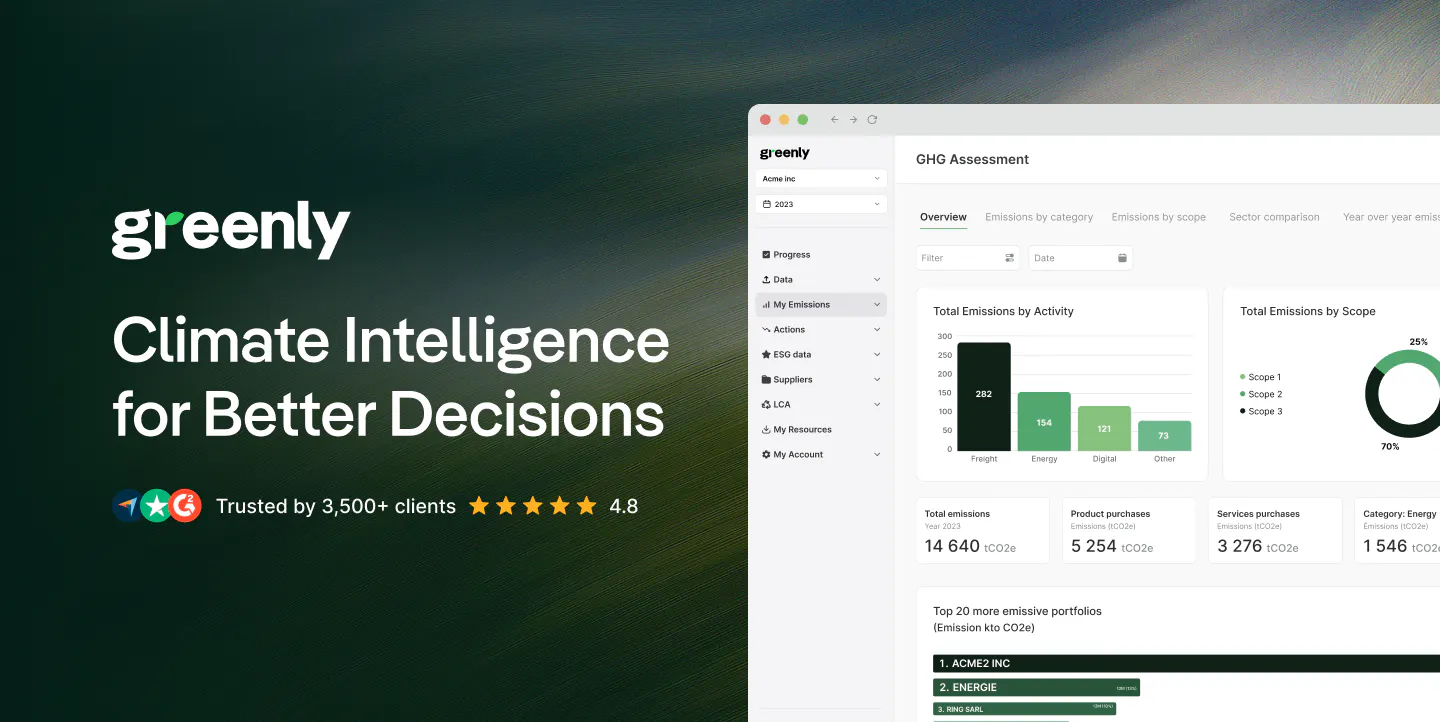
- A quarter of your scope 3 is already quantified before your first supplier request: Greenly's database covers 200,000+ suppliers and 30,000+ supplier-specific emission factors, giving 25% coverage from day one.
- Automatic enrichment finds whatever suppliers have already published elsewhere: in one recent client project spanning 3,500 suppliers, 16% of the footprint was covered from public sources alone, before a single request went out.
- Greenly reaches a 70% supplier response rate against an industry average of 30%, asking once and never for data it can already find.
- Non-responders don't block the report either: once enough primary data is collected, category-level extrapolation covers the remaining gap, with extrapolated values progressively replaced as more real supplier data arrives.
- A guided LCA approach covers three cases: no data (an agent walks the supplier through their first LCA), an existing LCA (imported and normalised), or partial data (completed with traced, validated assumptions), aligned to ISO 14067, CSRD and SBTi.
Every figure carries its source, its confidence level and its history, so it's defensible in front of an auditor. When emissions fall year over year, you can show it's a genuine reduction rather than a change of method. See Greenly's scope 3 supplier-engagement platform for the full feature set.
Watershed
Best for: companies that want hands-on advisory support paired with funded decarbonisation action, not just a measurement report.
Watershed treats scope 3 as an advisory problem as much as a measurement one. Rather than compete on how much supplier data it can collect, its real differentiator is a genuine in-house Sustainability Advisory team, backed by a track record of turning measurement into funded, real-world emissions reductions.
- A dedicated Sustainability Advisory team, serving more than 20% of the Fortune 500, works directly with customers on decarbonisation planning, science-based target setting, and regulatory disclosure across CSRD, UK SRS and CDP: closer to a consulting engagement than a support ticket.
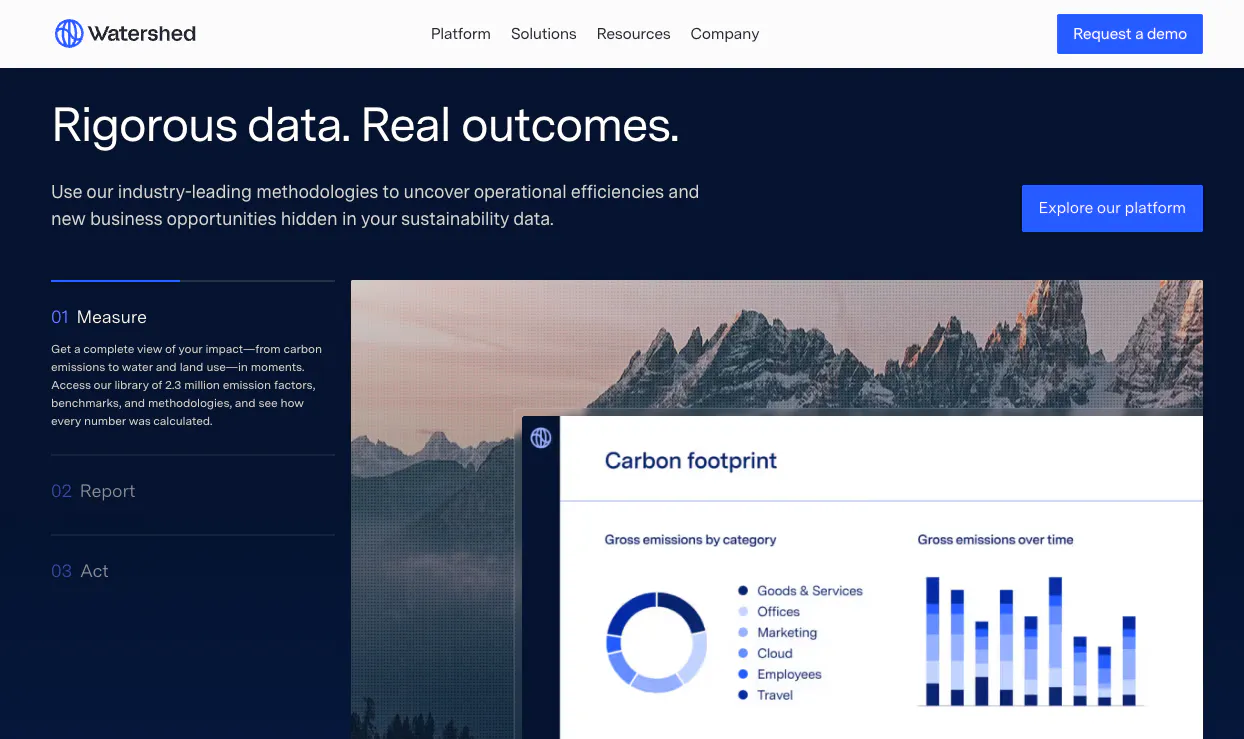
- Product Footprints, an AI tool, breaks a specific product down into its constituent materials and manufacturing processes, drawing on a database of over 2.3 million emission factors across 148 countries.
- Supplier engagement tooling exists too, including a guided portal and ranking suppliers by emissions impact, but the more distinctive move is funding supplier-side action directly rather than only measuring it.
- With Canva, Watershed co-designed a Virtual Power Purchase Agreement bringing the company's print suppliers together to co-fund new solar capacity: avoiding over 15,000 tonnes of CO2 a year, around 16% of Canva's 2022 footprint, with suppliers themselves benefiting from lower electricity costs.
Per its own 2026 Sustainability Report, Watershed's platform now spans over 800 companies managing a combined 3.5 billion tonnes of CO2e. The trade-off runs the opposite way to Greenly's: you're paying for expert judgement and access to funded reduction projects, not for the deepest possible supplier database, and that advisory-heavy model tends to suit larger, better-resourced teams more naturally than a smaller company weighing the mid-sized criteria above. For the full one-on-one, see Greenly's comparison with Watershed.
Persefoni
Best for: groups that need audit-grade rigour across multiple regulatory regimes at once.
Persefoni treats carbon as accounting material. It's aimed first at organisations whose main challenge is standing up to an auditor or regulator, rather than mobilising a supply chain.
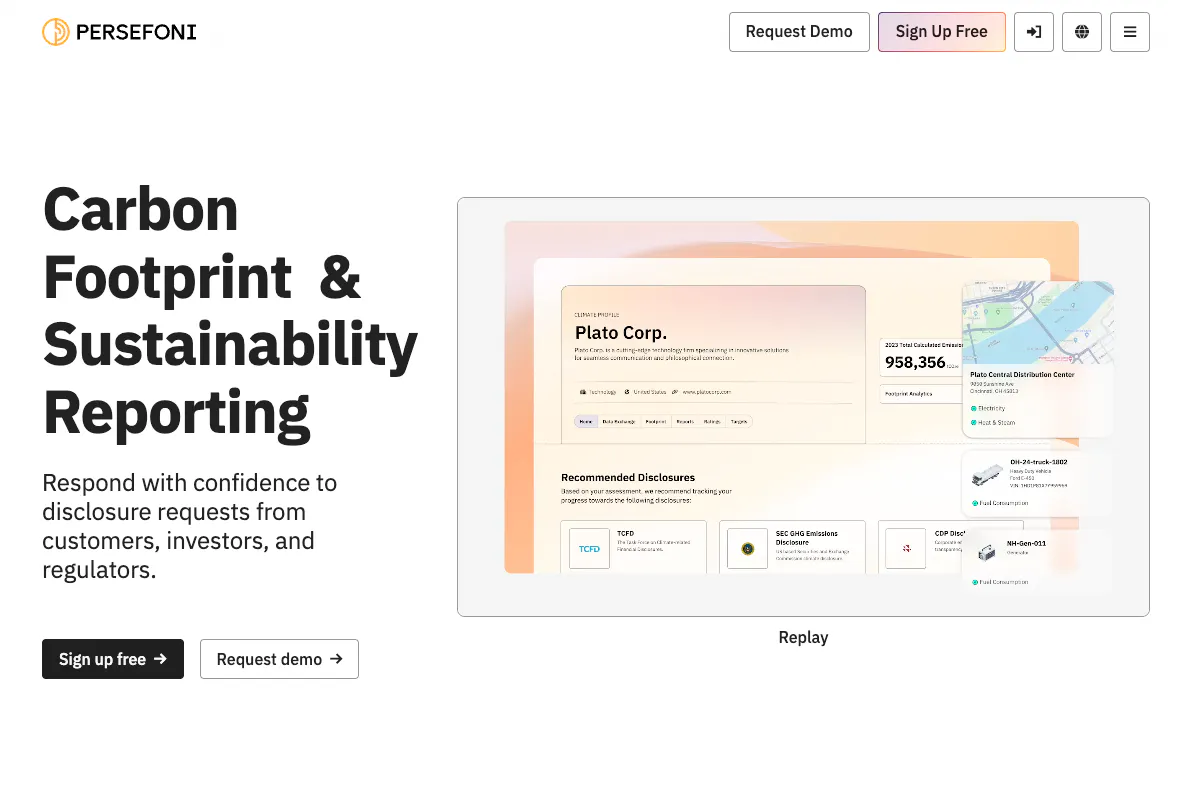
- Its Footprint Ledger attaches every tonne of reported carbon to an entry, the way a financial ledger attaches every transaction: useful when the question is “where does this figure come from” rather than “where do we reduce.”
- Regulatory coverage spans CSRD, ISSB and CDP, plus the US regimes (SEC climate rules and California's SB 253 and SB 261), of real interest to groups exposed to both European and American reporting simultaneously.
- PersefoniAI adds anomaly detection and automatic emissions-factor matching with a conversational assistant, though it sits on the client side rather than reaching into the supplier relationship.
- Persefoni was recognised as one of the first PCAF-accredited SaaS vendors in 2023, having codified the PCAF standard for financed emissions back in 2021. Its clearest area of maturity remains loan and investment portfolios.
The method starts from spend-based estimation, then refines it with supplier data on the first 100 to 200 accounts. That works well for framing an order of magnitude; it assumes you're comfortable with most of the supplier base staying modelled rather than measured. For the full one-on-one, see Greenly's comparison with Persefoni.
Frequently asked questions about Scope 3 emissions software
What's the best scope 3 software for a company with no in-house sustainability team?
Look for automated data collection, automated supplier outreach, and expert support built into the subscription rather than billed as consulting. Platforms designed for that profile, including Greenly, are built around exactly this.
Which carbon tracking software includes scope 3?
Most dedicated carbon accounting platforms cover scope 3 to some degree, but coverage quality varies hugely: the real question is whether a platform gives you supplier-specific data or only spend-based estimates across all 15 categories.
What are the 15 scope 3 categories?
The GHG Protocol's Corporate Value Chain (Scope 3) Standard splits scope 3 into 15 categories across upstream activities (like purchased goods and business travel) and downstream activities (like product use and end-of-life disposal).
Why is scope 3 so hard to measure?
Because the activity generating the emissions happens outside the company's own operations. A company can switch its own fleet to electric vehicles, but it can't directly control whether a supplier three tiers up the chain uses renewable energy.
About Greenly

If you've read this far, you already know where spend-based estimates fall short: they can point to a purchasing category, but never to the supplier actually driving the emissions. That's the specific problem Greenly's scope 3 platform is built to solve, through primary data collection rather than statistical estimation.
In practice, that means your company doesn't start from zero. Greenly's database already covers over 200,000 suppliers and 30,000+ supplier-specific emission factors, so a quarter of your footprint is typically quantified before a single request goes out. From there, supplier engagement takes over: a 70% response rate against an industry average of 30%, guided LCA support for suppliers with no data of their own, and full traceability so every figure can be defended to an auditor.
See Greenly's scope 3 supplier-engagement platform for the full feature set.
Watershed, “Watershed Supply Chain,”

Watershed, “Canva x Watershed customer story,”
Watershed, “Senior Sustainability Advisor, Engagement Manager (careers page, confirms Advisory team scope),”
Sustainability Magazine, “Watershed: Driving Global Corporate Environmental Action,”
Persefoni, “Get Ready for California Climate Disclosure,”
Persefoni, “CARB's Preliminary List for California SB 253 & SB 261: What Companies Need to Know,”
Persefoni, “PCAF: Reporting Standard Beginner's Guide,”
Partnership for Carbon Accounting Financials, “PCAF announces Persefoni as partner to support the financial sector's decarbonization,”
GHG Protocol, “Corporate Value Chain (Scope 3) Accounting and Reporting Standard,”
GHG Protocol, “Scope 3 Calculation Guidance,”
Science Based Targets initiative, “Corporate Net-Zero Standard,”
California Air Resources Board, “California Greenhouse Gas Reporting and Climate-Related Financial Risk Disclosure Initial Regulation,”
International Organization for Standardization, “Reducing carbon footprint made easier with new International Standard,”
UK Government, Department for Business and Trade, “UK Sustainability Reporting Standards,”
UK Government, Department for Business and Trade, “UK Sustainability Reporting Standards: UK SRS S1 and UK SRS S2,”
Share this article


