

Supplier engagement is what allows a company to manage its upstream footprint: measuring it, setting expectations for it, and helping suppliers bring it down. Because a company’s climate impact rarely stops at its own walls. It runs through the factories, farms, and service providers that supply everything the company buys, and CDP, the nonprofit behind the world’s largest corporate climate disclosure system, puts that upstream footprint at roughly 26 times what a company produces directly.
California’s SB 253 adds urgency, as large companies doing business in the state must begin reporting Scope 3 emissions, the category that captures supplier-related impact, starting in 2027. Building a usable supplier data pipeline takes years, though, so companies that start collecting this data now will be the ones with something to report when the deadline lands.
Supplier engagement and supplier relationship management (SRM) solve different problems, despite the overlapping vocabulary.
On average, supply chain emissions run about 26x higher than a company’s own direct footprint (CDP).
Scope 3 reporting becomes mandatory under California’s SB 253 in 2027, which means supplier data pipelines need to be built well before then.
A five-step framework, grounded in the GHG Protocol and SBTi’s own guidance, can take a program from mapping suppliers to tracking results.
Results are real, but they’re rarely fast. Even leading US companies fall well short of their Scope 3 targets years into a supplier engagement program.
What Is Supplier Engagement?

Supplier engagement is the structured process by which a company collects data from its suppliers, sets expectations for their environmental performance, and supports them in reducing their impact, typically as part of a Scope 3 emissions reduction strategy.
Supplier engagement is the practice of working directly with a company’s suppliers to measure, manage, and reduce the environmental impact of the goods and services they provide, most often their greenhouse gas emissions. It covers everything from collecting emissions data through supplier surveys to helping suppliers set their own science-based targets and supporting them with training, incentives, and shared resources. Some sources use the term vendor engagement instead, though supplier engagement is the more common phrasing in climate and procurement contexts.
What’s the Difference Between Supplier Engagement and Supplier Relationship Management (SRM)?
Procurement teams already have a name for working with suppliers: supplier relationship management, or SRM, sometimes called vendor management. The two terms get used interchangeably online, but they cover different ground. SRM manages a supplier relationship on the metrics that have always mattered to procurement: cost, quality, delivery, contract terms. Supplier engagement, at least in the climate sense used throughout this article, narrows in on one dimension of that relationship: environmental and climate performance.
Here’s how the two compare directly:
| Supplier Relationship Management (SRM) | Supplier Engagement | |
|---|---|---|
| Primary focus | Cost, quality, delivery, and overall relationship health | Environmental and climate performance, particularly greenhouse gas emissions |
| Typically owned by | Procurement and sourcing teams | Sustainability or ESG teams, working alongside procurement |
| Core metrics | On-time delivery rate, defect rate, cost savings, contract compliance | Emissions data coverage, share of suppliers with science-based targets, questionnaire response rate |
| Common tools | ERP and procurement platforms, supplier scorecards | Carbon accounting software, CDP questionnaires, EcoVadis assessments |
| When it matters most | Every supplier relationship, regardless of sustainability profile | Suppliers with material emissions or compliance exposure, such as Scope 3 reporting obligations |
In practice, expect the line to blur further over time. Procurement teams have an obvious incentive to fold climate criteria into their existing scorecards, and sustainability teams have every reason to borrow SRM’s playbook for structured supplier communication rather than build a parallel one from scratch. Still, treating supplier engagement as its own initiative, with its own owner and success metrics, makes it far easier to hold suppliers accountable on emissions specifically, rather than letting that goal dissolve into a broader relationship-management process.
Why Does Supplier Engagement Matter Right Now?
California’s SB 253 is a good example of how quickly the ground is shifting under this. The California Air Resources Board has already proposed pushing the initial Scope 1 and Scope 2 reporting deadline from August to November 2026, and the Scope 3 requirement, the one built entirely on supplier data, is still set for 2027. That kind of movement is normal for a new regulation finding its footing, but it also means companies waiting for a fully settled deadline before they start collecting supplier data are chasing a moving target.
There’s a financial case too, separate from the regulatory one. CDP puts the potential cost of climate-related supply chain risk at $162 billion, and puts the upstream opportunity value, the savings and revenue tied to supplier decarbonization, at $165 billion: more than eight times the roughly $20 billion needed to unlock it.

Elfrun Von Koeller
Managing Director and Partner, BCG, March 2023
Most US companies aren’t close to capturing that value yet. EcoVadis’s 2026 ratings index found that 72% of US companies fall into the Insufficient or Partial range on sustainable procurement. Only 26% of large US companies conduct supplier risk analysis before engaging suppliers at all, compared with 56% in the Nordic region. The bar for a genuinely differentiated program is still low, and that gap won’t stay open forever.

Three numbers make the case for acting now: a 2027 deadline for Scope 3 reporting under SB 253, $165 billion in financial value CDP ties to managing supply chain climate risk, and a 72% majority of US companies not yet positioned to capture it.
That combination, regulatory pressure, financial upside, and a market that hasn’t caught up, sets up the next real question: how does a company actually build a program?
How Do You Build a Supplier Engagement Program?
GHG Protocol and SBTi have each published detailed guidance on this, and the frameworks overlap enough to combine into one five-step strategy. The real difficulty shows up in sequencing: getting the same suppliers through all five stages without the effort stalling out after the first data request.
Map & Prioritize
Start with the suppliers that account for the most spend or emissions.
Get Buy-In
Align procurement, finance, legal, and leadership before reaching out.
Set Requirements
Be specific about what data or action is expected, and why.
Support Suppliers
Back requirements with training, tools, and direct help.
Track & Incentivize
Monitor progress and reward the suppliers who deliver.
Map Your Supply Chain and Prioritize Suppliers
Some suppliers matter more than others when a program is just getting started. GHG Protocol’s guidance recommends beginning with the suppliers that make up the largest share of spend or estimated emissions, often the top 80% by either measure. That’s usually a small fraction of the full supplier list, which makes the first phase far more manageable than trying to engage every vendor at once. This is where supplier tiering earns its keep: grouping suppliers into Tier 1, Tier 2, and Tier 3 based on how directly they touch the business helps clarify which relationships to prioritize first.
Get Internal Buy-In Before Reaching Out
A supplier engagement program touches more internal teams than most people expect at the start. Procurement usually owns the supplier relationship day to day, but finance needs to understand any cost implications, legal has to review new contract language, and leadership needs to back the initiative publicly enough that suppliers take it seriously. SBTi’s guidance treats this alignment step as a prerequisite. Skip it, and the gap tends to surface later as inconsistent messaging across different supplier conversations.
Set Clear, Specific Requirements
Vague requests get vague responses. GHG Protocol’s guidance walks through a structured communication sequence: explain why the company is asking, specify exactly what data or action is expected, set a realistic deadline, offer a point of contact for questions, and confirm receipt once a supplier responds. Skipping steps in that sequence, especially the explanation of why, is one of the more common reasons supplier response rates stay low. For companies that already have a supplier code of conduct or a broader supplier management policy, this is the natural place to reference it: requirements tied to an existing, formal document tend to land with more weight than a one-off data request.
Back Requirements With Real Support
Requirements alone rarely move a supplier that doesn’t know how to meet them. Smaller suppliers in particular often lack the staff or expertise to build an emissions inventory from scratch. SBTi’s guidance points to a mix of group training sessions, shared calculation tools, and direct one-on-one support as the difference between a program that gets responses and one that gets excuses. None of this needs to be expensive: a single webinar walking suppliers through a basic emissions calculation can unlock responses from companies that would otherwise ignore a cold data request.
Track Progress and Use Incentives
A program needs a way to show whether any of this is working. That means tracking metrics like data completion rates, the share of suppliers with a stated reduction target, and year-over-year progress against a baseline. Incentives push those numbers further: preferred-supplier status, extended contract terms, or public recognition for the strongest performers all give suppliers a reason to treat a request as more than paperwork. SBTi’s guidance lists supplier incentives, alongside communication, training, and data collection, as one of the areas worth revisiting once a program is a year or two in.
What Tools and Platforms Support Supplier Engagement?
A handful of suppliers can be managed with spreadsheets and email threads. A few hundred can’t. Once a program covers dozens or hundreds of suppliers, the tracking problem multiplies fast: who’s been contacted, who responded, whose data is missing, whose numbers don’t add up… This is the point where supplier engagement software earns its place, centralizing data collection, automating reminders, and keeping a single record of who’s responded and who hasn’t.
Most supplier engagement platforms cover similar ground: a supplier-facing portal for questionnaires and data collection, automated follow-ups, scorecards or dashboards to track response rates over time, and enough of an audit trail to support a Scope 3 disclosure later. What varies more is how directly that technology connects to the rest of a company’s carbon accounting. Supplier emissions data living in a separate system from the rest of a company’s inventory usually means manual re-entry before it’s actually usable.
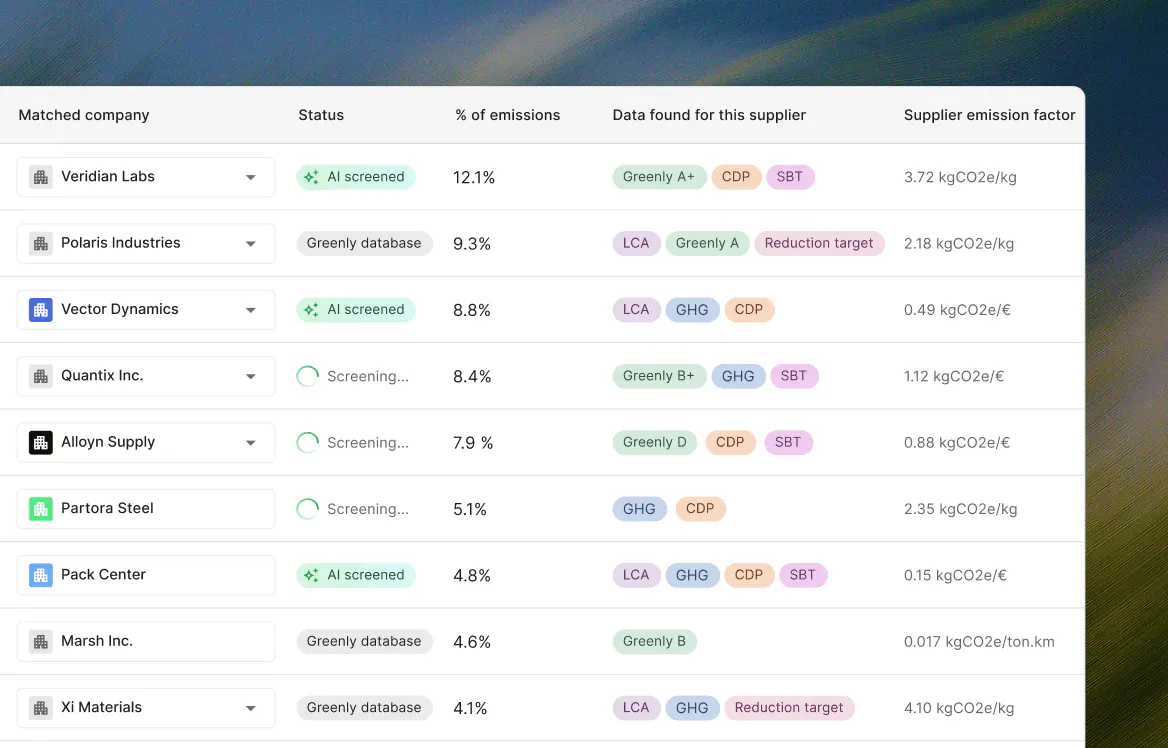
Greenly’s Sustainable Procurement module leads with data a company can get without contacting a single supplier: matching the supplier list against a database of 200,000+ known suppliers, then pulling public SBTi and CDP disclosures to close more gaps. Outreach only goes to suppliers where a real gap remains, and even then it’s a guided questionnaire rather than a blank form. Validated data replaces spend-based estimates in Scope 3 reporting automatically, on the same platform used for the rest of a company’s carbon accounting.
Alexis Normand
Co-founder and CEO, Greenly, November 2022
What Does Supplier Engagement Look Like in Practice?
Two companies show what the process looks like once it leaves a five-step framework and meets a real supply chain: Target, a retailer, and Salesforce, a software company with a much smaller physical footprint but its own Scope 3 challenge.
Target requires its major suppliers to complete CDP’s Climate Questionnaire and asks them to set their own science-based targets for Scope 1 and Scope 2 emissions. Target set a goal for 80% of supplier spend to have science-based Scope 1 and 2 targets by 2023. By the end of fiscal year 2024, that figure stood at 75%, and Target has since sunset the original goal in favor of ongoing collaboration. Progress on Scope 3 emissions overall, the number tied to SB 253, has been slower: a 5.6% reduction against a 2030 target of 32.5%. Target’s Forward Renew program, which helps suppliers switch to renewable electricity, added more than 125 participants in 2024 alone, and a separate partnership with the Apparel Impact Institute has funded emissions-reduction projects across 59 factories in nine countries since 2018.
Salesforce took a different route: writing the requirement directly into supplier contracts. It took about nine months to go from concept to rollout before a single supplier saw the new terms. Since April 2021, its Sustainability Exhibit has required covered suppliers to set a science-based target as a condition of doing business, working toward a goal of 60% of supplier emissions covered by science-based targets by 2024. A portion of executive pay is tied to how much of that spend goes to suppliers who’ve made the commitment. Suppliers who fall short can fund carbon offset projects or renewable energy instead of facing a flat penalty, a mechanism Salesforce calls its Climate Positive Remedy. Suppliers unable to complete formal SBTi validation can sign an attestation confirming their target meets SBTi’s criteria instead.
Mechanism
Voluntary supplier goal, backed by a renewable-energy support program.
Key metric
75% of supplier spend with Scope 1/2 targets (FY2024); Scope 3 down 5.6% against a 32.5% 2030 goal.
Timeframe
Supplier program active since 2019, ongoing.
Mechanism
Contractual requirement, tied to executive pay.
Key metric
Working toward 60% of supplier emissions covered by science-based targets.
Timeframe
Contract requirement since April 2021, ongoing.
Both companies count as leaders in this space, and both are still short of their own targets years into the effort.
Does Supplier Engagement Actually Reduce Emissions?
A 2025 peer-reviewed study in Frontiers in Sustainable Energy Policy took a hard look at this question and found that supplier engagement programs often struggle to deliver measurable Scope 3 emissions reductions, pointing to mismatched data standards between buyers and suppliers and the high transaction costs of running a program at scale. That finding holds even for programs endorsed by SBTi, the same standard-setter whose framework much of this article draws from.
There’s a more optimistic data point, too. EcoVadis’s own ratings data shows companies rated for ten years or more average a score of 63.2, compared with 51.5 for companies rated for the first time. That gap doesn’t prove causation by itself, but it does line up with what Target’s numbers suggest: results build slowly, over years of repeated engagement, rather than in the first reporting cycle.
Target’s own Scope 3 progress, a 5.6% reduction against a 32.5% target discussed above, fits the same pattern: real movement, but slower than the target-setting exercise implied it would be.


Supplier engagement rarely produces fast results, and any program promising otherwise should be treated with some skepticism. The programs that do show real progress, Target’s and Salesforce’s included, share one trait: they’ve been running for several years. The first couple of reporting cycles mostly surface data quality problems and slow supplier response rates. Results tend to show up later, once those kinks get worked out.
Frequently Asked Questions about Supplier Engagement
How do you improve supplier engagement?
The biggest lever is usually communication. Explaining why a request matters, keeping the ask specific, and following up consistently outperforms sending a longer or stricter questionnaire. After that, incentives like preferred-supplier status or extended contract terms, and direct support like training and calculation tools, tend to move response rates further.
What is the CDP Supplier Engagement Assessment (SEA)?
The Supplier Engagement Assessment, or SEA, is CDP’s scoring system for how well a company manages the environmental performance of its suppliers. It was previously called the Supplier Engagement Rating (SER), and some sources still use the older name. A company’s SEA score reflects factors like whether it sets supplier-specific emissions targets, includes climate criteria in supplier contracts, and works directly with suppliers on reduction plans.
Does SB 253 require companies to engage their suppliers?
Not directly. SB 253 requires large companies to report Scope 3 emissions, not to run a supplier engagement program specifically. But accurate Scope 3 reporting is nearly impossible without supplier data, so the reporting requirement tends to force engagement even without naming it as a separate legal obligation.
What’s the difference between Tier 1, Tier 2, and Tier 3 suppliers?
Tier 1 suppliers sell directly to a company under a direct contract. Tier 2 suppliers supply those Tier 1 suppliers with raw materials, and Tier 3 suppliers sit further upstream still, providing specialized components or services. Most supplier engagement programs start with Tier 1, since that’s where a company has the most direct leverage and the clearest data access.
How long does it take to see results from a supplier engagement program?
Longer than most companies expect. Target’s program has been running since 2019 and has reduced Scope 3 emissions by 5.6% against a 32.5% target so far. EcoVadis data shows companies rated for 10 or more years average a score of 63.2, compared with 51.5 for first-time participants. A realistic timeline is measured in years, not quarters.
What About Greenly?
Building a supplier engagement program from scratch, tracking who’s responded, whose data is missing, whose numbers need review, gets harder fast as a supplier list grows. Greenly’s platform folds that tracking into the same system used for the rest of a company’s carbon accounting, keeping supplier data and Scope 3 reporting in one place instead of two.
CDP, "Supply Chain,"

CDP, "Supplier Engagement Assessment,"
CDP, "Companies Failing to Engage Suppliers on Nature and Climate Despite Incoming Regulation,"
Greenly, "Greenly Launches Its New Supplier Engagement Solution to Help Companies Reduce the Carbon Footprint of Their Supply Chain,"
Future of Sourcing Digital Publication, "Innovations in Sourcing: Salesforce, Inc.,"
California Air Resources Board (CARB), "California Corporate Greenhouse Gas (GHG) Reporting and Climate Related Financial Risk Disclosure Programs,"
Regbase, "SB 253,"
EcoVadis, "Index 2026,"
EcoVadis, "What EcoVadis Data Reveals About the Sustainability Performance of More than 10,000 US Companies,"
GHG Protocol, "Supplier Engagement Guidance,"
Science Based Targets initiative (SBTi), "Engaging Supply Chains on the Decarbonization Journey: Executive Summary,"
Lahd, Holly, "Corporate Decarbonization Strategies and Carbon Accounting Standards: Implementation Learnings to Inform Standard Revisions," Frontiers in Sustainable Energy Policy, 2025
Target Corporation, "Climate,"
Science Based Targets initiative (SBTi), "Supplier Engagement Case Study - Salesforce,"
Share this article


