Scope 3 Emissions Software: How the Top 3 Platforms Stack Up


By Agnès Potier-Murphy, International Copywriter, on 09/14/2026
Three platforms come out on top for scope 3 emissions software: Greenly, best for collecting real supplier data instead of running estimates; Watershed, best for pairing expert advisory work with funded decarbonization projects; and Persefoni, best for audit-grade rigor and multi-framework compliance. If you've been searching more broadly for the best carbon accounting software, this is the narrower, scope-3-specific version of that same question. Which platform is right for you comes down to your company's size and how far along your climate program already is. Below, you'll find the criteria for judging any scope 3 platform, a side-by-side comparison, and a deep dive into all three.
Scope 3 emissions usually account for 70-90% of a company's total footprint, and almost none of it happens inside your own operations. It's your suppliers, your products once they're in customers' hands, and whatever happens after disposal. That's exactly why scope 3 software (sometimes marketed as supply chain emissions software or GHG accounting software) is a fundamentally different purchase than a Scope 1/2 tool: it has to pull real data out of a supply chain you don't control, or bring in outside expertise to act on what that data reveals, not just crunch numbers you already have on file.
Greenly, Watershed, and Persefoni each tackle a different piece of the scope 3 puzzle: primary supplier data, advisory-led decarbonization, and audit-grade accounting, respectively.
Company size drives which criteria matter most. Smaller teams need automation that doesn't require in-house climate expertise; large enterprises need ERP connections, multi-entity rollups, and a clean audit trail.
The federal picture just got murkier: the SEC formally proposed rescinding its climate disclosure rule in May 2026, while California's SB 253 and SB 261 remain fully in force. If you sell into California or report to investors who track climate risk, state law is what matters right now, not what's happening in Washington.
Spend-based estimates can tell you which purchasing category is driving your footprint, but they can't tell you which supplier is.
What to Look for in Scope 3 Emissions Software
Scope 3 software is built to help companies measure, track, and report emissions that happen up and down their value chain: emissions a company doesn't directly cause or control, but is still on the hook for. Think employee commutes, how customers use your product once they've bought it, or what happens to it once it's thrown away.
Three forces are driving this regardless of company size. Enterprise buyers are asking for supplier-level emissions data before they'll even shortlist a vendor. Regulatory pressure hasn't gone away, it's just relocated: the SEC's 2024 climate disclosure rule is on its way out, but California's SB 253 and SB 261 are still very much alive, and the EU's CSRD reaches plenty of American companies with European operations or revenue. And internally, the team that actually knows your suppliers (procurement) usually isn't the team writing the disclosure (sustainability or finance).
The SEC angle trips a lot of people up, so it's worth unpacking. The agency adopted its climate disclosure rule back in March 2024, but the rule was stayed within weeks and never actually took effect. On May 29, 2026, the SEC formally proposed rescinding the rule in its entirety, a proposal published in the Federal Register that June. Here's the part that gets lost in the coverage: even while the rule was alive, it never touched Scope 3 in the first place, only Scope 1 and 2. California's rules are the ones with real teeth for Scope 3. SB 253 requires large companies doing business in the state to report their full value chain footprint, including Scope 3, and SB 261 requires disclosure of climate-related financial risk. Both apply regardless of what ultimately happens to the SEC's rule. If your company has any exposure to California, that's the requirement to build toward, not a federal rule that's being walked back.
Greenly, Watershed, and Persefoni made this list based on the criteria below.
Criteria Every Buyer Should Check
| Criterion | What to check |
|---|---|
Emissions factor database |
Look for a platform pulling from more than one recognized emissions factor database, refreshed at least annually, with last year's version kept on file for comparison. |
Calculation traceability |
A figure should trace back to the specific invoice or ledger line behind it, conversion factor included. Without that trail, the number won't hold up under audit. |
Scope 3 coverage and methodology |
The full 15 categories should be accounted for, with any category marked not applicable backed by a written rationale, and every figure labeled clearly as either measured data or a spend-based estimate. |
Compliance-ready reporting |
This is where a genuine scope 3 reporting tool earns its price tag: the platform should turn your data directly into a finished disclosure, whether that's for CSRD, SBTi, or California's SB 253 and SB 261. Manually reformatting a spreadsheet every filing season defeats the point. |
Data portability |
Your emissions data is yours, full stop, even three years and one vendor switch from now. You should be able to pull a clean export on demand, not a PDF screenshot, without filing a support ticket. |
Built-in expertise |
The best platforms pair the software with a real person: someone who reviews your assumptions, understands your business, and signs off on the final number before it goes out the door. |
What Mid-Sized Companies Should Prioritize
For mid-market buyers evaluating scope 3 software, the constraint is almost always the same: nobody on staff has done a life-cycle assessment before. The platform has to get you to a usable, defensible number without that expertise in-house.
| Criterion | What to check |
|---|---|
Automated data ingestion |
Your existing systems, accounting first, should feed the platform directly instead of routing through spreadsheets. Bonus points if the AI can go find gaps in your data on its own. |
Automated supplier outreach |
Surveys go out, reminders get sent, and responses come back integrated, all without anyone re-typing a single line. This is the step that actually turns a guess into a number. |
Built-in expert review |
A real specialist checks your boundaries, your assumptions, and your result before it ships, covered by your subscription instead of billed as a separate consulting engagement. |
Pre-formatted disclosures |
Whatever you need next, a CDP response, an EcoVadis submission, or a one-pager for a lender, should come straight out of your existing data with no spreadsheet gymnastics in between. |
Straightforward pricing |
One number should cover deployment, seats, and every reporting cycle after that. Ask what year three costs, not just what year one costs. |
What Large Companies Should Prioritize
At enterprise scale, the problem isn't finding data, it's that you have too much of it scattered across systems, and every number has to survive an actual audit. These are the criteria that separate the platforms built for that reality from the ones that aren't.
| Criterion | What to check |
|---|---|
ERP and API connections |
Battle-tested connectors into your procurement and finance stacks, a documented API, and a supplier portal that handles its own reminders and quality checks. Ask directly: how many spreadsheets does a finance team still have to hand-build every year? |
Multi-entity rollups |
Perimeters that flex by ownership stake or operational control, across currencies and countries, with entities that join or exit mid-year handled cleanly. Skip this and every acquisition corrupts your historical trend line. |
Set-and-forget automation |
Your data already lives in the ERP, the procurement tool, payroll, and expense systems. The platform should connect once and resync on its own schedule instead of making someone run a fresh export every quarter. |
Reporting by business unit and trajectory |
Results should be sliceable by subsidiary, site, product line, or division, with SBTi-aligned reduction paths modeled at each level. The real test: can a subsidiary lead see their own number and their own target. |
Supplier-level LCA support |
The platform should collect primary supplier data where it exists and, where it doesn't, generate a defensible life-cycle assessment using documented assumptions, ideally with guided supplier onboarding and the ability to normalize LCAs a supplier already has on hand, in line with ISO 14067, CSRD, and SBTi. |
A real audit trail |
Version history on every emissions factor, locked reporting periods once they're published, a timestamped log of every change, and sign-off controls by role. This is the list your external auditor actually works through. |
Greenly vs. Watershed vs. Persefoni: Scope 3 Software Side-by-Side
Before the deep dive, here's the fast version. All three platforms are legitimately good at different things, so the checkmark matters less than the reasoning behind it.
| Criterion | Greenly | Watershed | Persefoni |
|---|---|---|---|
Core data approach |
Database-first factor matching, plus direct supplier engagement | Supplier engagement tools, though the headline feature is a named Sustainability Advisory team | Spend-based by default, refined with supplier data on top accounts |
Data available before outreach |
25% of supplier-specific factors matched before contacting a single supplier | No published day-one figure | Not applicable: the starting point is a spend-based estimate |
Supplier response rate |
70%, against a 30% industry average | No published response-rate figure | Capped at the first 100-200 accounts by design |
Life-cycle assessment support |
Three-path guided LCA, aligned to ISO 14067 | Not a core focus: an AI tool (Product Footprints) maps specific products to materials and processes, not a full guided LCA | Not a core focus: built around ledger accounting and financed emissions |
Advisory and funded action |
Expert review comes with the subscription; no funded supplier decarbonization program | In-house Sustainability Advisory team; funds supplier-level decarbonization directly (e.g., Sweetgreen's supplier-level dairy sourcing shift) | Not a core focus: the AI assistant works on your own data, not supplier-facing |
Best for |
Companies that need real supplier data at scale, not another spend-based estimate | Companies that want hands-on advisory support paired with funded decarbonization action, not just a measurement report | Organizations that need audit-grade rigor across several regulatory regimes at once |
The Top 3 Scope 3 Software Platforms, Reviewed
Greenly
Best for: companies that need real supplier data at scale, not another spend-based estimate.
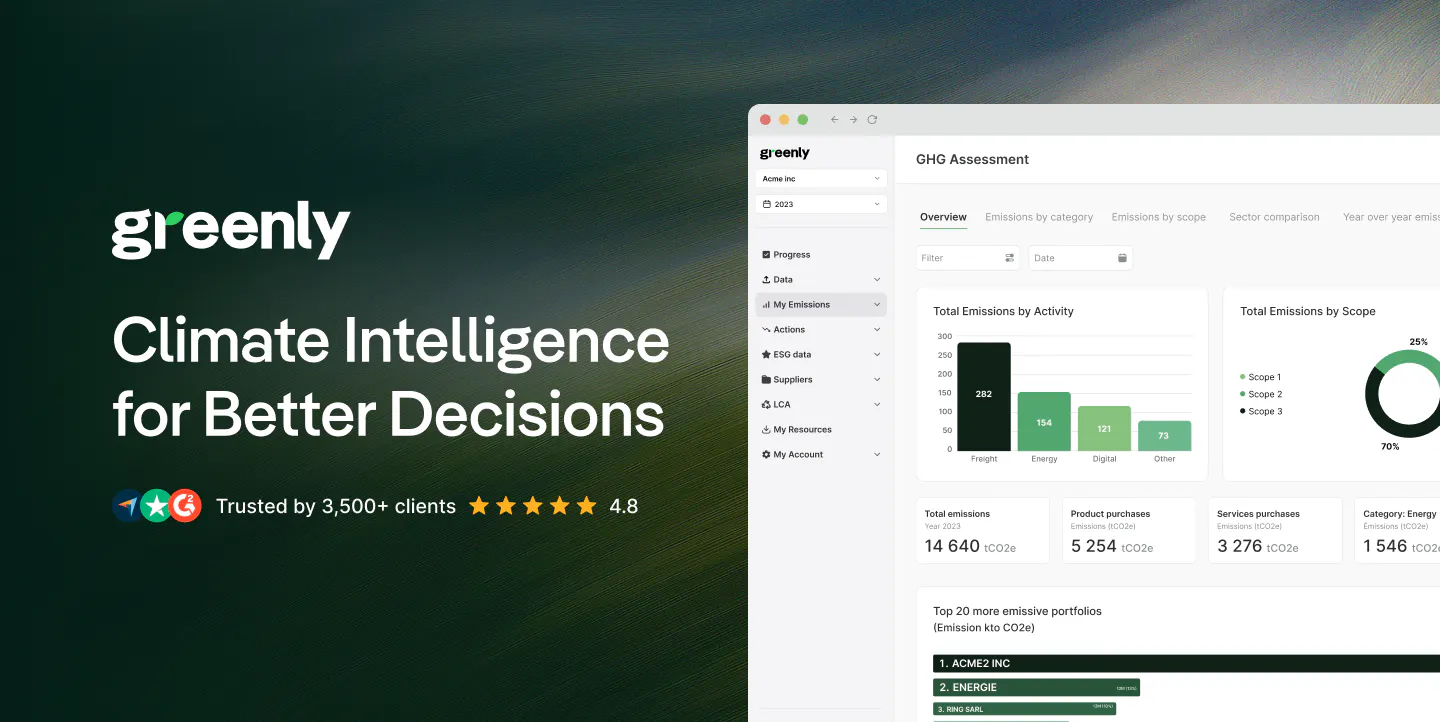
Of the three, Greenly is the scope 3 software built specifically around collecting primary data instead of modeling around it. Where a generic estimate stops at a category-level guess, Greenly's approach names an actual supplier, an actual product, and an actual next step, not just a ballpark figure.
- You're not starting from zero: Greenly's database covers 200,000+ suppliers and 30,000+ supplier-specific emission factors, matching about a quarter of your scope 3 before you've contacted a single supplier.
- Whatever your suppliers have already published publicly gets pulled in automatically. On one recent client project across 3,500 suppliers, that alone covered 16% of the footprint before a single outreach email went out.
- Greenly's own benchmark is a 70% supplier response rate versus a 30% industry average, and it gets there by never asking twice for data it can already find on its own.
- Suppliers who don't respond still don't hold up the report. Category-level extrapolation fills the gap in the meantime, and each estimate gets swapped out for real data as it comes in.
- Guided LCA support covers three scenarios: no data at all (a guided workflow walks the supplier through their first assessment), an existing LCA (imported and standardized), or partial data (filled in with documented, traceable assumptions), all aligned to ISO 14067, CSRD, and SBTi.
Every number comes with its source, its confidence level, and a full history attached, which is what makes it defensible to an auditor. And when your footprint drops year over year, you can actually prove it's a real reduction and not just a change in how you calculated it. See Greenly's scope 3 supplier engagement platform for the full feature set.
Watershed
Best for: companies that want hands-on advisory support paired with funded decarbonization action, not just a measurement report.
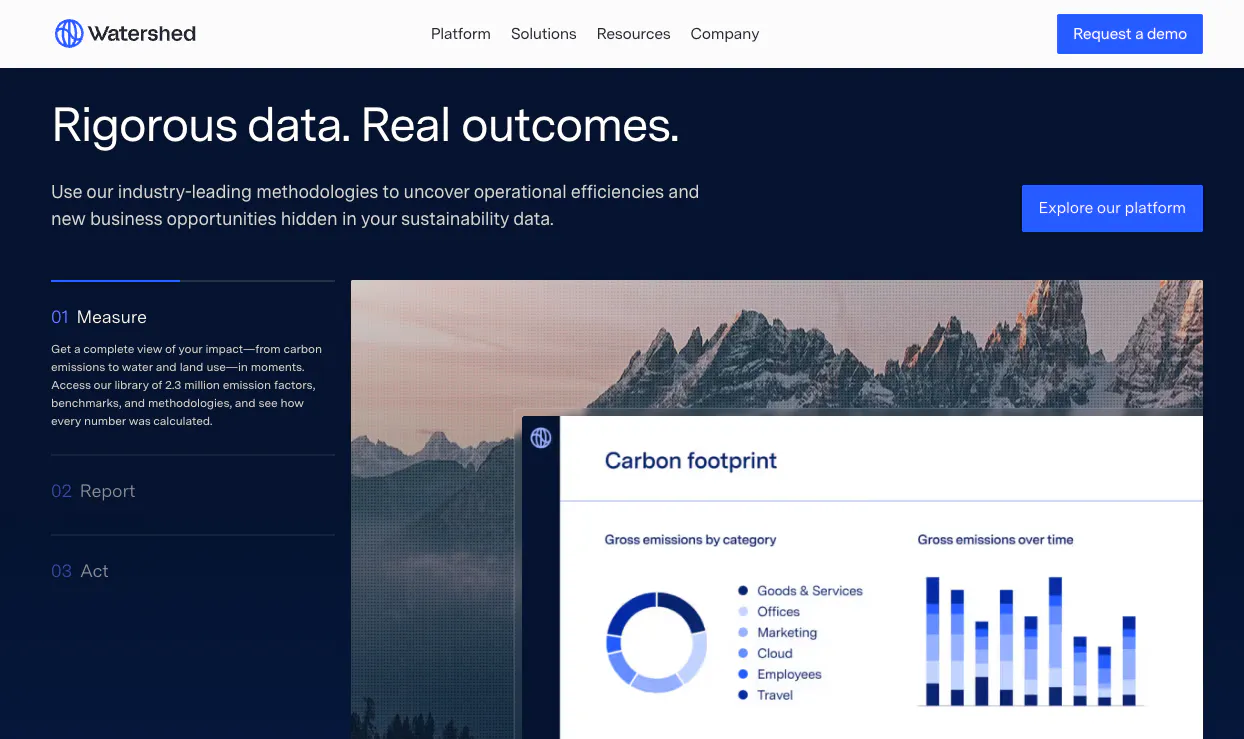
Watershed's pitch is different from the other two: it treats scope 3 as much as an advisory relationship as a data problem. Instead of competing on how many suppliers it can reach, its differentiator is a real in-house Sustainability Advisory team and a track record of turning a measurement into an actual funded reduction project.
- More than 20% of the Fortune 500 work with Watershed's Sustainability Advisory team directly on decarbonization roadmaps, science-based targets, and disclosure across CSRD, California's SB 253 and 261, and CDP: closer to hiring a consultant than opening a support ticket.
- Product Footprints, an AI feature, decomposes a single product down to its materials and manufacturing steps, backed by a database of over 2.3 million emission factors spanning 148 countries.
- There's supplier-facing tooling too, including a portal and impact-based ranking, but it's not the headline act. The more distinctive play is funding the reduction directly instead of only measuring it.
- The clearest example is much closer to home: Sweetgreen worked with Watershed to trace its footprint down to individual supplier practices, like cattle feed and manure handling on specific dairy farms, then used that granular data, not industry averages, to choose lower-carbon suppliers and fund farm-level changes directly. The result: a public commitment to cut emissions per dollar of revenue in half by 2027, with the company's menu already running about 30% less carbon-intensive than the average U.S. diet.
Watershed's own 2026 Sustainability Report puts its platform at over 800 companies managing a combined 3.5 billion metric tons of CO2e. The trade-off is basically the inverse of Greenly's: you're paying for expert judgment and access to funded projects, not the deepest possible supplier database, and that consulting-heavy model tends to fit larger, better-resourced teams more comfortably than a smaller company weighing the mid-market criteria above. For the full head-to-head, see Greenly's comparison with Watershed.
Persefoni
Best for: organizations that need audit-grade rigor across several regulatory regimes at once.
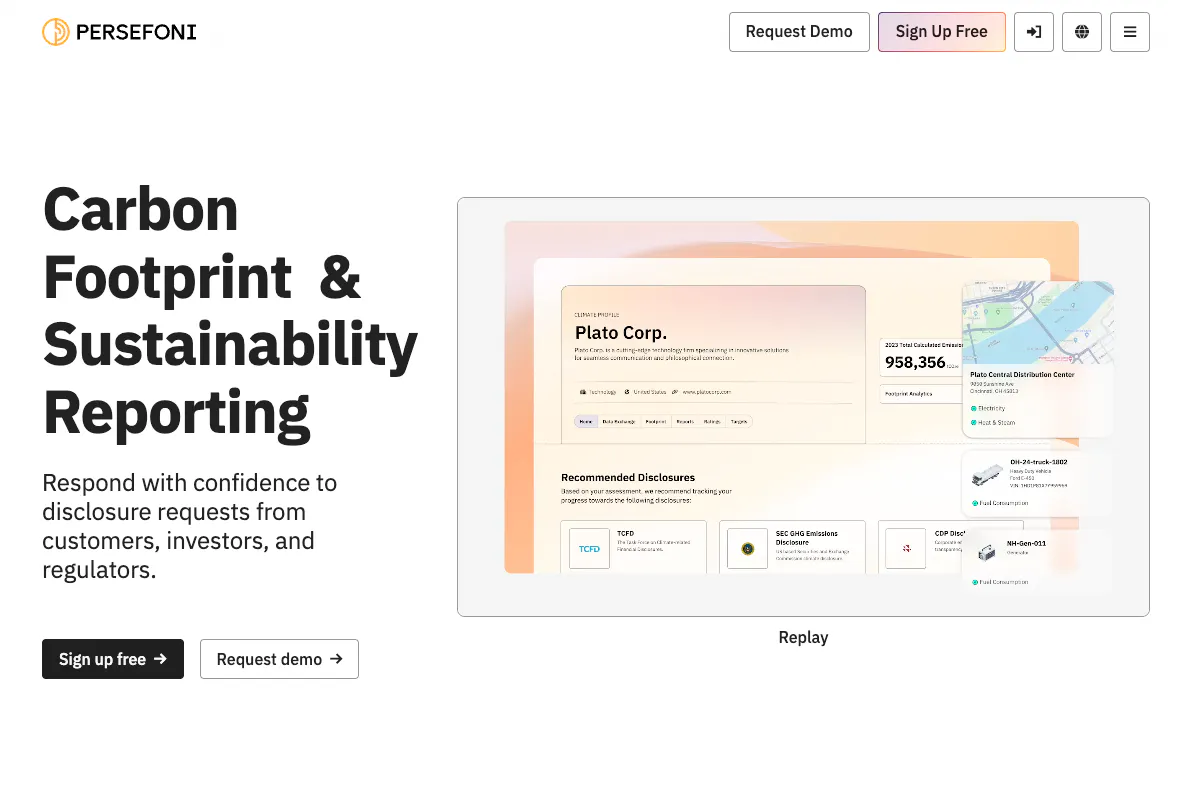
Persefoni approaches carbon the way a finance team approaches a general ledger. It's built first for organizations whose hardest problem is standing up to an auditor or a regulator, not mobilizing hundreds of suppliers.
- Its Footprint Ledger ties every reported ton of carbon to a specific entry, the same way a financial ledger ties every dollar to a transaction, which matters most when the question you're answering is “where did this number come from” rather than “how do we cut it.”
- Regulatory coverage runs across CSRD, ISSB, and CDP, plus SEC climate disclosure and California's SB 253 and SB 261. That last pair is the one that's actually enforceable today; the SEC's own rule is the one currently headed for the exit.
- PersefoniAI layers in anomaly detection and automatic emissions-factor matching through a conversational assistant, though it's built to work on your own data rather than reach out into your supplier base.
- Persefoni was one of the first SaaS vendors PCAF ever accredited, back in 2023, having helped codify the PCAF standard for financed emissions in 2021. Financial-portfolio carbon accounting is still where it's strongest.
The starting point is a spend-based estimate, refined with supplier data on your top 100 to 200 accounts. That's a reasonable way to size the problem; it also means most of your supplier base stays modeled rather than measured. For the full head-to-head, see Greenly's comparison with Persefoni.
Frequently Asked Questions about Scope 3 Emissions Software
What's the best software for tracking carbon emissions if my company has no sustainability hire?
Prioritize automated data collection, automated supplier outreach, and a real person built into the subscription instead of billed separately. Platforms aimed at that exact profile, Greenly among them, are built around solving for it.
Which carbon tracking software actually includes scope 3?
Almost every carbon accounting platform claims some scope 3 coverage, but the depth varies enormously. The real question isn't whether a tool covers scope 3 on paper, it's whether it gives you supplier-specific numbers or just spend-based estimates dressed up across all 15 categories.
What are the top carbon accounting software platforms?
It depends heavily on what you're optimizing for. Greenly, Watershed, and Persefoni each lead on a different axis: primary supplier data, advisory-led decarbonization support, and audit-grade multi-framework compliance, respectively, which is exactly why a single “best overall” list tends to miss the point.
Why is scope 3 so much harder to measure than scope 1 or 2?
Because the activity causing the emissions happens outside your own operations entirely. You can electrify your own fleet tomorrow if you want to; you can't force a supplier two tiers up your chain to switch to renewable power.
Is the best carbon accounting software also the best scope 3 software?
Not necessarily. Broad carbon accounting suites often bolted scope 3 on after building out scope 1 and 2 first, so it can feel like an afterthought inside the product. If scope 3 is your actual bottleneck, a platform built around it from the start, like the three compared here, usually beats a general-purpose suite that treats it as one feature among many.
About Greenly

By now the theme should be clear: a spend-based estimate can flag a purchasing category, but it can't hand you a supplier's name. Greenly built its scope 3 platform to close exactly that gap, running on primary data instead of statistical modeling.
That starts before you've sent a single email. Greenly's database already covers 200,000+ suppliers and 30,000+ supplier-specific emission factors, putting roughly a quarter of your footprint on solid ground from day one. From there, it's a 70% supplier response rate against a 30% industry average, guided LCA support for suppliers with no data to offer, and a paper trail solid enough to hand an auditor without flinching.
See Greenly's scope 3 supplier engagement platform for the full feature set.
Watershed, “Watershed Supply Chain,”

Sweetgreen, “Carbon Neutral,”
Watershed, “Senior Sustainability Advisor, Engagement Manager (careers page, confirms Advisory team scope),”
Sustainability Magazine, “Watershed: Driving Global Corporate Environmental Action,”
Persefoni, “Get Ready for California Climate Disclosure,”
Persefoni, “CARB's Preliminary List for California SB 253 & SB 261: What Companies Need to Know,”
Persefoni, “PCAF: Reporting Standard Beginner's Guide,”
Partnership for Carbon Accounting Financials, “PCAF announces Persefoni as partner to support the financial sector's decarbonization,”
California Air Resources Board, “California Greenhouse Gas Reporting and Climate-Related Financial Risk Disclosure Initial Regulation,”
Federal Register, “Rescission of Climate-Related Disclosure Rules,” 91 Fed. Reg. 33296 (June 3, 2026)
GHG Protocol, “Corporate Value Chain (Scope 3) Accounting and Reporting Standard,”
GHG Protocol, “Scope 3 Calculation Guidance,”
Science Based Targets initiative, “Corporate Net-Zero Standard,”
International Organization for Standardization, “Reducing carbon footprint made easier with new International Standard,”
Share this article


